The phrase “ocean acidification” suggests seas slowly turning into something like vinegar. That is not what is happening: seawater is still alkaline today. So why do scientists use the word, and why does a change of a few tenths of a pH unit matter so much to shells, corals and fisheries?
What ocean acidification actually means
Ocean acidification is the ongoing decrease in the pH of the ocean. Between 1950 and 2020, the average pH of the ocean surface fell from about 8.15 to 8.05. A pH of 7 is neutral, and anything above it is basic, so the ocean remains alkaline, with a pH above 8. “Acidification” describes the direction of travel, toward a lower pH, not a destination.
The small numbers are misleading because the pH scale is logarithmic. A drop of just 0.1 in pH corresponds to a 26% rise in the concentration of hydrogen ions, the particles that make water more acidic. What looks like a rounding error is a real chemical shift.
Where the change comes from
The cause is the same carbon dioxide that drives global warming. The ocean absorbs roughly a quarter of human CO2 emissions: from 1850 to 2022, it took up 26% of everything emitted by human activity. Atmospheric CO2 has climbed from about 280 parts per million before the industrial era to more than 422 ppm in 2024, and the ocean is constantly exchanging gas with that air.
Once dissolved, CO2 forms carbonic acid, which splits into bicarbonate and hydrogen ions. The extra hydrogen ions lower the pH, and they also bind with carbonate ions, the building blocks that many marine organisms use to make shells and skeletons out of calcium carbonate. Chemists track this with a “saturation state”: above a value of 1, calcium carbonate does not readily dissolve. As carbonate becomes scarcer, that margin shrinks. One form of calcium carbonate, aragonite, is more soluble than the other, calcite, so creatures that build with aragonite may be more exposed.
This is why the phenomenon is sometimes called “the other CO2 problem” or even “the evil twin of global warming.” It does not depend on temperature at all, only on how much CO2 the water absorbs.
A concrete example on the Great Barrier Reef
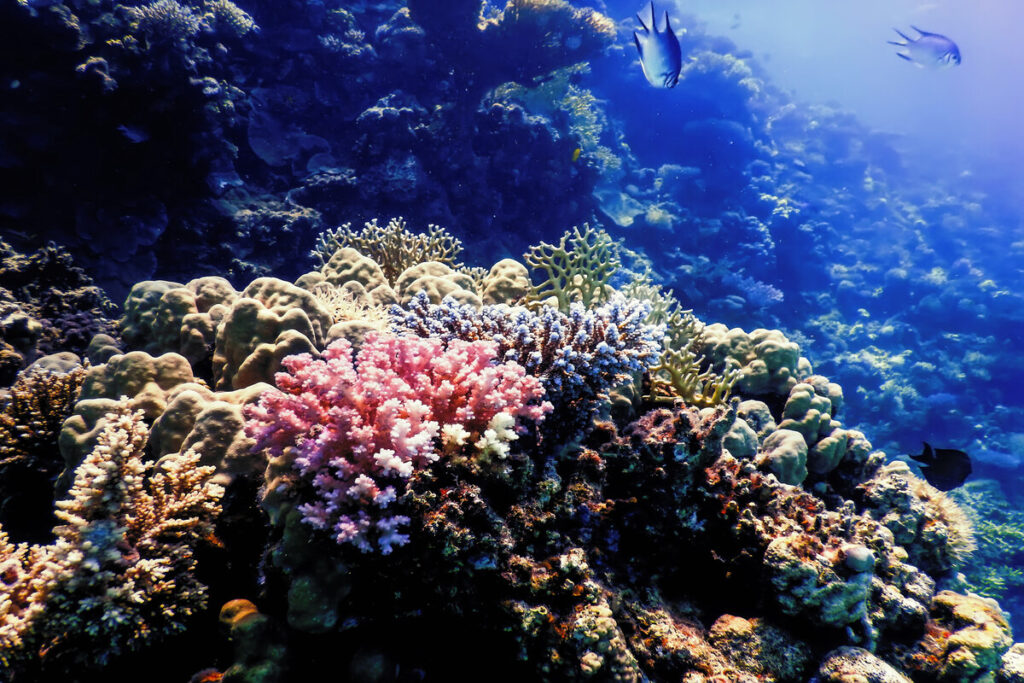
Researchers tested the effect directly on a 400 square metre patch of the Great Barrier Reef. When they raised the water’s pH to near pre-industrial levels, net calcification, the rate at which the reef builds itself, increased by 7%. When they lowered the pH to the level expected after 2050, net calcification fell by 34%.
The stakes go beyond coral. Pteropods, tiny swimming snails that are a key prey in Arctic food webs, see their shells dissolve as acidification increases. In the United States, 73% of the value of fisheries worth $3.8 billion in 2007 came from calcifying species and their direct predators. Coral reefs support around a quarter of marine life, and about 1 billion people depend partly or wholly on them for fishing, tourism and coastal services.
What is often misunderstood
The ocean is not one uniform tank
pH varies naturally from place to place. Upwelling, where deep water rises to the surface, already brings water undersaturated in aragonite onto the Pacific continental shelf from Vancouver to Northern California. Acidification adds to this natural variability rather than replacing it.
Not every species responds the same way
A sediment core from the North Atlantic showed that the average mass of coccoliths, the chalky plates of a type of plankton, actually rose by 40% between 1780 and 2004. A 2007 to 2012 field study in Queensland and Western Australia found corals more resistant to acidification than expected, with heat stress posing the bigger threat.
It has happened before, but not this fast
About 56 million years ago, during the Paleocene-Eocene Thermal Maximum, ocean pH dropped by roughly 0.3 units. Today, carbon is being added about ten times faster than during that event, which is why the current rate of change is described as unprecedented in the geological record.
Where things go from here
Projections depend directly on emissions. Under a low emissions scenario, average surface pH would reach about 8.0 by 2100. Under a very high emissions scenario, it could fall to around 7.7. Experimental ideas such as adding alkalinity to seawater are being studied, but they remain at an early stage and carry their own risks, so cutting CO2 emissions remains the main way to address the root cause.
As oceanographer Jean-Pierre Gattuso noted in 2015, “The ocean has been minimally considered at previous climate negotiations.” The sea is not turning into acid, but it is steadily losing the chemistry that shell builders rely on. For more on how different gases shape the climate, see why methane matters for short-term warming and what is really behind today’s warming.