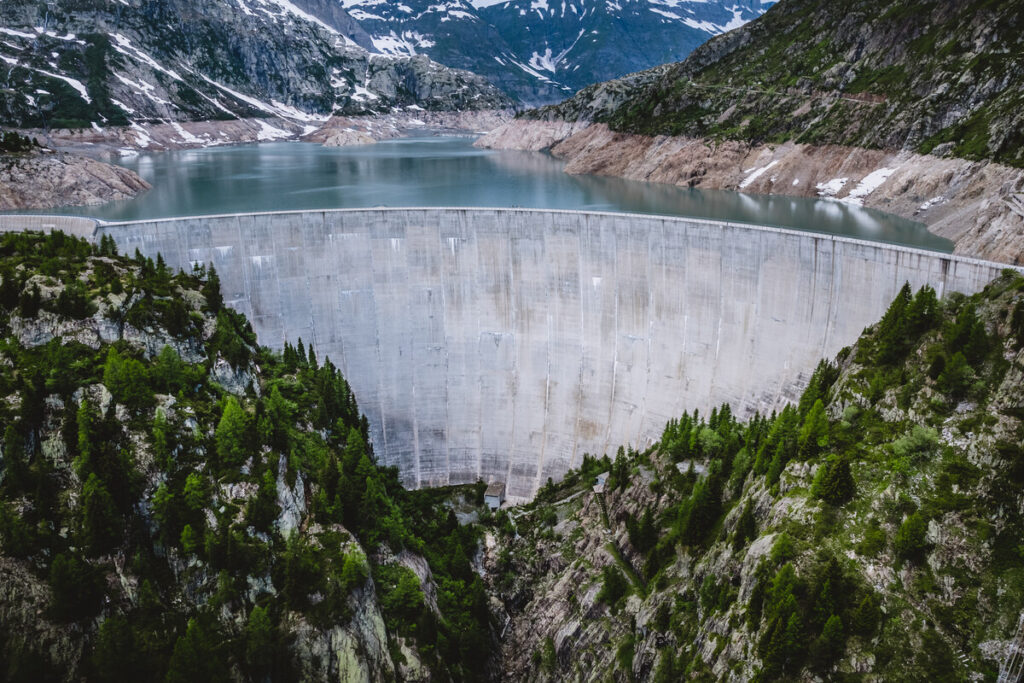
Wind and solar power get most of the attention, but a much older technology quietly decides how far they can go. Pumped hydro storage, a system that moves water uphill and lets it fall again, holds most of the world’s grid storage today. Here is how it works, and why it matters.
What pumped hydro storage actually is
Pumped-storage hydroelectricity stores energy as the gravitational potential energy of water. A plant has two reservoirs, one higher than the other. When there is surplus electricity on the grid, usually cheap off-peak power, pumps move water from the lower reservoir to the upper one. When demand rises, the water is released back down through turbines to produce electricity again.
Most plants use reversible turbines that work as a pump in one direction and as a generator in the other. In simple terms, it behaves like a giant rechargeable battery made of water and height.
Why storage matters for wind and solar
Solar and wind are intermittent: output depends on sunshine and wind, which change from day to day and month to month. A grid has to match supply and demand at every moment, so surplus power produced at noon or on a windy night needs somewhere to go.
Pumped hydro fills that gap. It can absorb extra generation, then supply it during peak demand. It also helps keep the grid stable through frequency regulation and reserve power, and it can respond to changes in demand within seconds. For a broader comparison of the main renewables, see our look at solar, wind and hydropower.
A technology older than most people think
The idea is not new. The first known use dates back to 1907, at the Engeweiher facility near Schaffhausen, Switzerland. In the United States, the Connecticut Electric and Power Company began using it in 1930 near New Milford, pumping water from the Housatonic River to a reservoir 70 metres higher. Reversible turbines arrived in the 1930s and made the design far more practical.
How big it has become
As of 2020, pumped hydro made up about 95% of all active storage installations worldwide. According to the International Hydropower Association, it provided 200 GW of power and 9,000 GWh of storage in 2025.
A concrete example: the Bath County station in the United States, one of the largest in the world, has a capacity of 3,003 MW and can store 24 GWh. The largest listed plant, Fengning in China, reaches 3,600 MW and 40 GWh. China is also the fastest-growing market, adding 7.75 GW of pumped storage in 2024 alone for a total of 58.69 GW.
What is often misunderstood
It does not create energy
Pumped hydro is a way to store electricity, not a source of it. Some energy is lost along the way: the round-trip efficiency is around 70% to 80%, once conversion losses and evaporation are counted. Its value lies in shifting power to the moment it is needed.
It cannot be built just anywhere
Plants need hilly terrain and a large height difference or large water flows, because the energy density of lifted water is relatively low. Capital costs are high. A plant needs roughly 1 gigalitre of water for its initial fill and around 10 hectares of land per GWh of storage, which explains why new projects are carefully sited.
Batteries are not simply replacing it
Battery storage is growing very fast, and China alone had 106.9 GW of battery capacity by May 2025. But the two technologies have different strengths. Pumped hydro plants can operate for decades, sometimes more than a century, which is three to five times longer than utility-scale batteries.
Where the idea is heading
Engineers are now testing variations that loosen the geographic limits. Closed-loop systems use two artificial reservoirs with no natural river inflow, and have the lowest carbon emissions per unit of storage among large-scale options. Other projects look at former mines, such as Callio in Finland with a height difference of 1,450 metres, or at seawater, as at the Rance site in France, which has partly worked this way since 1966.
None of these is a single solution on its own. Yet as wind and solar take a bigger share of electricity, the quiet work of moving water up and down a hill is likely to remain part of how the lights stay on.