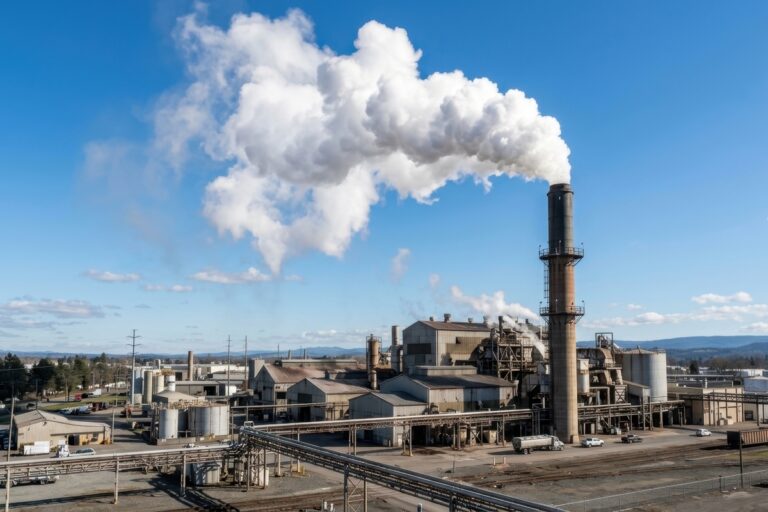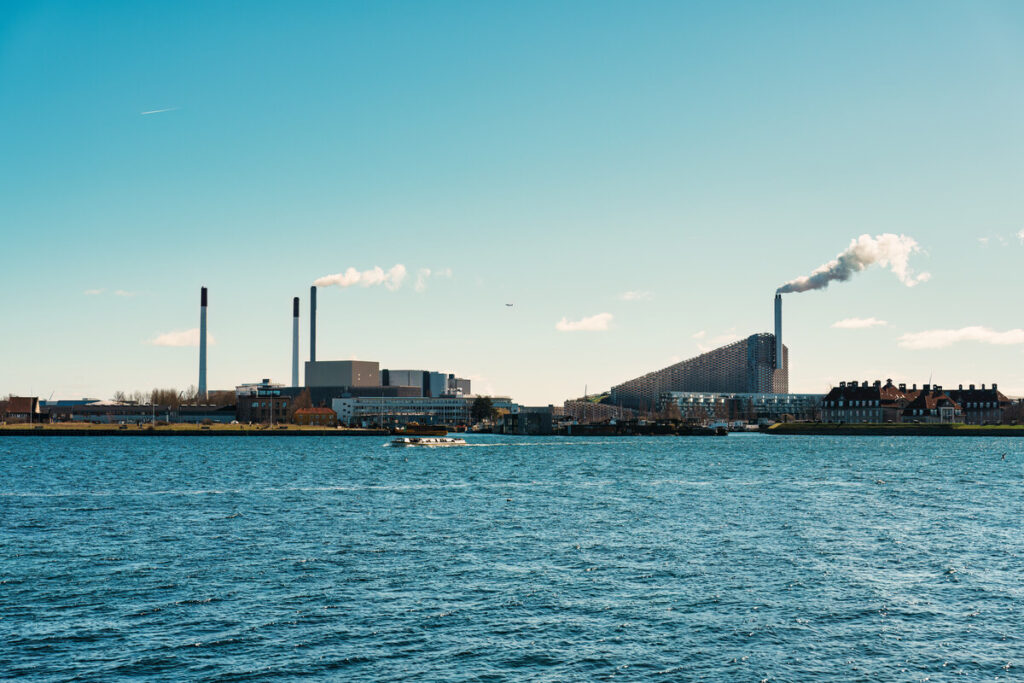
In a small Danish port town, a power station, an oil refinery, a drug maker and a plasterboard factory spent decades swapping steam, gas, water and gypsum. Nobody designed it as a green project, yet it became the world’s best-known example of industrial symbiosis.
What industrial symbiosis actually means
Industrial symbiosis is a branch of industrial ecology. It describes separate businesses that exchange materials, energy, water or by-products, so that what one company treats as waste becomes another company’s input. Resources stay in productive use for longer, companies cut costs, and less is taken from the ground. It is often described as a stepping stone toward a circular economy.
Being close together helps, but it is not enough on its own. Strategic planning, collaboration and a steady flow of information matter just as much. One practical obstacle is that by-products are usually labelled as waste, so they are rarely listed or traded anywhere, which makes it hard for a potential buyer to even know they exist.
How the Kalundborg network grew, one deal at a time
The Kalundborg story starts in 1959 with the Asnæs power station, a 1,500 MW coal-fired plant. The first exchange came in 1972, when the Gyproc plasterboard plant began receiving surplus gas from the nearby refinery by pipeline. In 1981 the municipality built a district heating network running on the power station’s waste heat.
From there the links multiplied. In 1982, pipelines started carrying steam from the power station to the Novo Nordisk pharmaceutical plant and the refinery, which allowed both to shut down inefficient boilers. In 1989, warm cooling water began feeding a fish farm raising trout and turbot. In 1993, the plant’s flue gas cleaning started producing gypsum, sold to Gyproc to replace imported natural gypsum.
Each link was negotiated as a separate business deal, and only went ahead if it was expected to pay off. That is the key detail: the network grew out of commercial logic over about 20 years, not out of a master plan.
What the companies swap
The network now counts nine public and private partners and more than 30 exchanges. A few examples:
- Steam from the power station covers 40% of the refinery’s steam needs, in return for the refinery’s waste gas
- Waste heat warms around 3,500 local homes
- Gypsum from the power station meets two-thirds of Gyproc’s needs
- Fly ash goes into cement and road building, and sludge from the fish farm is sold to farmers as fertilizer
- The refinery pipes 700,000 cubic metres of cooling water a year to the power station
The savings are real, if approximate. In 1997, the power station saved 30,000 tonnes of coal by burning refinery gas, and 200,000 tonnes of fly ash and clinker were kept out of landfill. Data from around 2004 points to 2.9 million cubic metres of groundwater saved every year. Overall, the exchanges are estimated to save up to $15 million a year, for investments of around $78.5 million.
Why it is harder to copy than it looks
Planned parks often failed
Kalundborg’s success sparked a wave of interest. In 1996, the US President’s Council on Sustainable Development proposed fifteen eco-industrial parks to test whether the model could be replicated. Research later found that parks forced into existence from the top down tended to fail, while the successful ones grew naturally, as Kalundborg did. Some organizations dropped the idea altogether.
Trust is part of the infrastructure
A researcher who studied how the Kalundborg network evolved concluded that a high level of trust between the companies was essential.
It is not a closed loop
Kalundborg is not self-sufficient: many trades happen with companies outside the park, and the network was built around a fossil fuel power station. Some potential remained unused, too. A 2002 study found that of 1.2 million cubic metres of refinery wastewater, only 9,000 were reused at the power plant. And most of the published savings figures are estimates.
What it says about greener business
A station manager in Kalundborg was the first to define the term, describing industrial symbiosis as “a cooperation between different industries by which the presence of each…increases the viability of the others”. Seen that way, it is less a technology than a habit: looking at a neighbour’s waste and asking whether it could be useful. In the UK, the National Industrial Symbiosis Programme has since put the concept to the test, a sign that the habit can travel beyond one Danish town, as long as it is given time to grow.