Albedo sounds like a word from an astronomy textbook, yet it quietly explains why a snowy field feels cooler than a dark parking lot, and why shrinking Arctic ice matters for the whole planet. Here is what the term actually means, how it shapes Earth’s temperature, and where its effects are less simple than they first appear.
A simple measure of how much sunlight bounces back
The word comes from the Latin albedo, meaning whiteness. In climate science, it describes the fraction of incoming sunlight that a surface reflects, on a scale from 0 (absorbs everything) to 1 (reflects everything). The term was introduced by the scientist Johann Heinrich Lambert in his 1760 work Photometria.
Real surfaces sit somewhere in between. Fresh snow reflects about 0.9 to 0.95 of visible light, while charcoal, one of the darkest substances, reflects only about 0.04. Most land areas fall between 0.1 and 0.4. Oceans and most forests look dark from a distance and have a low albedo, while deserts are among the brightest landforms.
Taken as a whole, Earth has an average albedo of about 0.3, much higher than the ocean alone, largely thanks to clouds. Today, satellites such as NASA’s MODIS instruments and the CERES sensors measure these values from space.
Why a few tenths make such a big difference
Every bit of sunlight that is not reflected is absorbed as heat, so albedo works like a dial on the planet’s energy balance. Together with the greenhouse effect, it helps keep Earth’s average surface temperature at about 15 °C (59 °F). The numbers show how sensitive that balance is: if Earth were entirely frozen, and therefore more reflective, its average temperature would drop below −40 °C, while a planet entirely covered by water would warm to almost 27 °C.
Location matters too. Polar regions have a high albedo and stay cold partly because they receive little sunlight, while the Sahara, also fairly bright, is hot because it receives so much.
The ice and albedo feedback loop
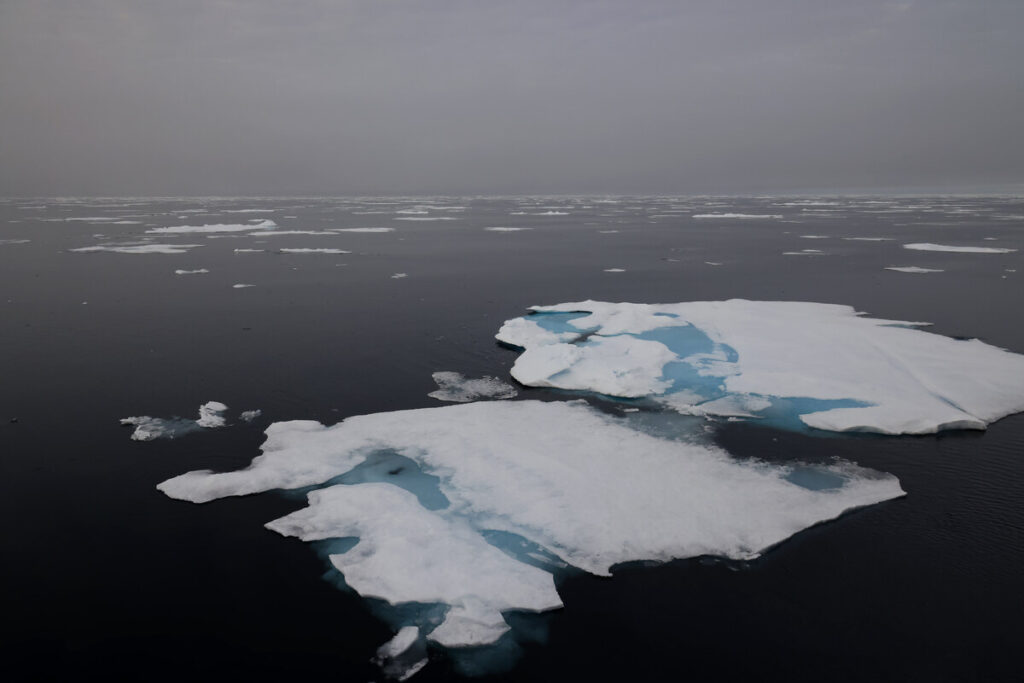
This is where albedo becomes central to climate change. Ice and snow reflect far more energy than open water or bare ground. When sea ice melts, darker seawater is exposed, absorbs more sunlight, warms, and melts more ice in turn. Scientists call this the ice and albedo feedback, a self-reinforcing loop listed alongside water vapour and clouds among the main amplifying feedbacks of the climate system.
Snow follows the same logic. Its albedo can fall from about 0.9 when freshly fallen to around 0.4 as it melts and as low as 0.2 when it is dirty, for example when windblown dust containing soot settles on glaciers.
Concrete ways people use albedo
Because the principle is so simple, it shows up in practical projects. In Switzerland, large white tarpaulins have been laid over glaciers to reflect sunlight. The method is very expensive, but it has been shown to reduce snow and ice melt by 60%.
Cities are another lever. Urban areas generally have an albedo 0.01 to 0.02 lower than nearby croplands, which adds to warming and to the urban heat island effect. A 2022 estimate found that raising the albedo of the world’s urban areas by 0.1 would produce a cooling effect equivalent to absorbing about 44 billion tonnes of CO2 emissions. In Almería, Spain, tens of thousands of hectares of whitened greenhouse roofs were found in a 2008 study to lower local surface temperatures, although the effect stayed localized.
Where albedo gets more complicated
Trees are dark, and that matters
Forests absorb most visible light for photosynthesis, so they have a low albedo. That extra absorbed heat can offset part of the carbon benefit of planting trees. Research by the Hadley Centre found that new forests in tropical and midlatitude areas tended to cool the climate, while new forests in high latitudes such as Siberia were neutral or perhaps warming. A 2023 study drawing on 176 flux stations worldwide suggested that afforestation could cause moderate warming for roughly 20 years before shifting to significant cooling.
Clouds work both ways
On any given day, about half of Earth is covered by clouds, which reflect more sunlight than land and water. That keeps the planet cooler, but clouds can also act like blankets that trap warmth, so their overall effect depends on the type of cloud.
A useful lens, not a quick fix
Albedo will not replace cutting emissions, and reflective projects tend to work locally rather than globally. Still, it is one of the clearest ways to see why ice loss, city design and land use all connect to the same question: how much of the sun’s energy Earth keeps, and how much it sends back to space.