El Niño gets blamed for floods, droughts and record-hot years, but what is it, exactly? And is it the same thing as climate change? The short answer is no, though the two are more entangled than they look.
A warm patch of ocean with a long reach
El Niño is the warm phase of the El Niño–Southern Oscillation (ENSO), a natural climate pattern in the tropical Pacific Ocean. Its cool counterpart is La Niña, and in between sits a neutral phase. The name is Spanish for “the boy”: Peruvian sailors used it for a warm current that tended to show up around Christmas, after the Christ Child.
The pattern swings irregularly, roughly every two to seven years. An El Niño typically lasts between nine months and two years, and the average gap between events is about five years.
How the Pacific switches modes
Normally, strong trade winds push warm surface water towards the western Pacific. The sea off Indonesia sits about half a metre higher than the sea off Peru, and cold, deep water rises along the South American coast to replace what the wind pushes away. The result is a Pacific that is roughly 8 to 10 °C cooler in the east than in the west.
During an El Niño, the trade winds weaken. Less cold water wells up in the east, warm water spreads eastward, and rain and clouds follow it. This is where a loop called the Bjerknes feedback comes in: weaker winds warm the eastern ocean, and a warmer eastern ocean weakens the winds further. Eventually the warm water in the west runs low and conditions drift back to normal. Scientists are still studying exactly what triggers each swing.
Why it nudges global temperatures
El Niño events cause short spikes in the global average surface temperature, usually lasting about a year, while La Niña events cause short-term cooling. That is why some years set heat records even though the long-term trend is slow and steady. The 1997-98 event, for example, briefly lifted air temperature by about 1.5 °C, against the 0.25 °C typical of an El Niño.
What it does to people and ecosystems
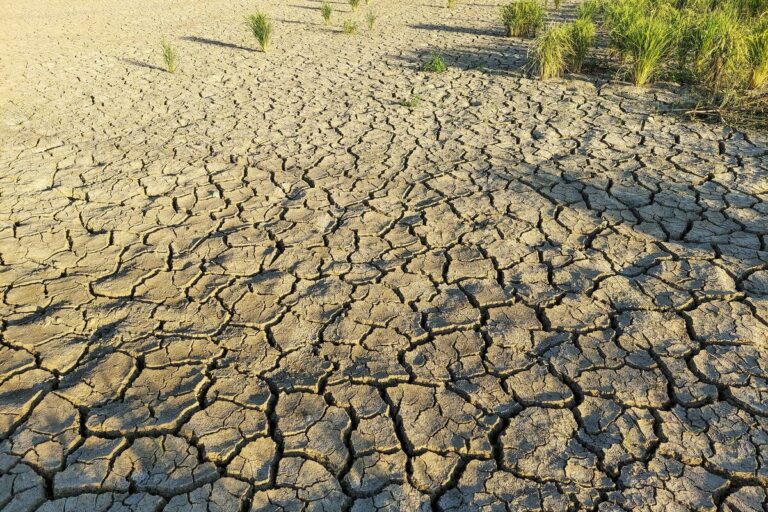
The effects are uneven. During the 2023 El Niño, drought cut maize harvests by up to 70% in parts of Zimbabwe, Zambia and Malawi, while East Africa saw flooding. El Niño years are also linked to higher risks of mosquito-borne diseases such as malaria and dengue.
Ecosystems feel it too. Mass coral bleaching was recorded in 1997-98 and 2015-16, and Peruvian and Chilean anchovy stocks have collapsed during several events. Tropical forests in the Amazon and Borneo have dried out and burned in strong El Niño years.
So is El Niño caused by climate change?
No. ENSO is a natural pattern, part of what scientists call internal climate variability, and it was shaping weather long before industrial emissions. Historians even link a strong event in 1789-1793 to poor European harvests ahead of the French Revolution.
The open question is whether warming changes how it behaves. Research since about 2019 suggests that climate change is increasing the frequency of extreme El Niño events, and a large model ensemble found about 10% more amplitude in the eastern Pacific between 1901-1960 and 1961-2020. Still, long observation records are needed to be sure. The IPCC’s Sixth Assessment Report put it this way:
“In the long term, it is very likely that the precipitation variance related to El Niño–Southern Oscillation will increase.”
What to take away
A helpful way to picture it: El Niño is the dice roll, and a warmer world loads the dice. El Niño does not create climate change, but a warming climate can make its droughts and floods hit harder. That is why forecasters watch the Pacific so closely, since early warnings give farmers, fishers and governments time to prepare.