Forests get most of the attention when people talk about storing carbon, but some of the most efficient stores grow where land meets sea. Blue carbon is the name for what mangroves, salt marshes and seagrass meadows quietly lock away.
What does blue carbon actually mean?
The IPCC defines blue carbon as “biologically driven carbon fluxes and storage in marine systems that are amenable to management”. In everyday use, the term mostly points to three coastal habitats: tidal marshes, mangroves and seagrass meadows, sometimes called “blue forests” to contrast them with land-based “green forests”. The word itself is recent. It was coined in 2009 to highlight that these coastal plants play a disproportionately large role in carbon storage.
Seaweed such as kelp is a more contested case. Estimates exist, but scientists still disagree on whether it can be counted as blue carbon.
Why the carbon stays put
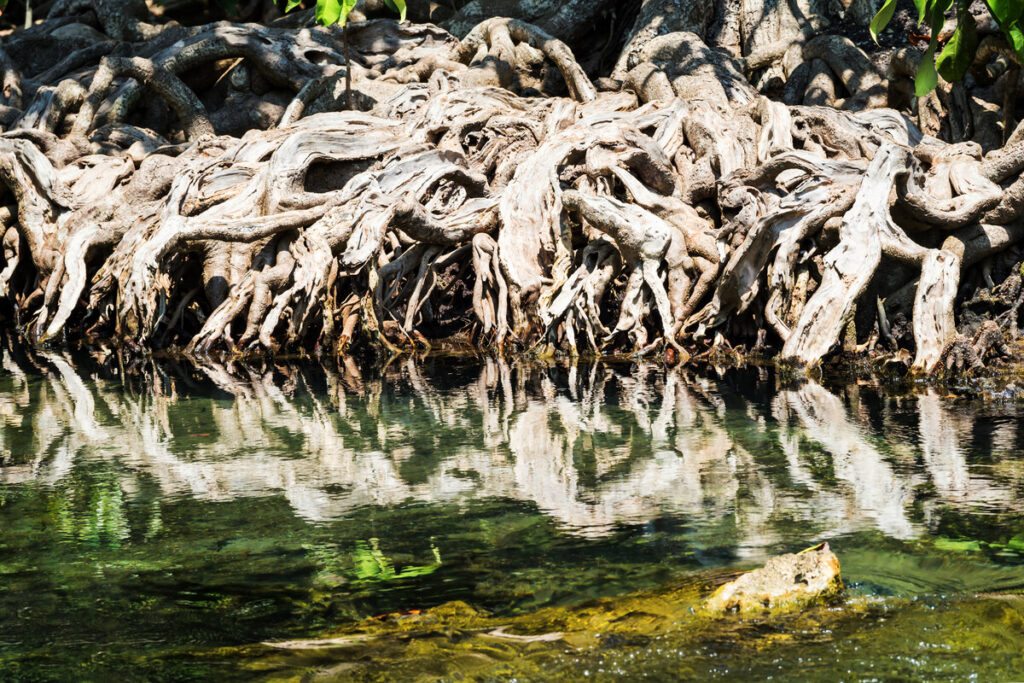
On land, a fallen tree rots and much of its carbon returns to the air. Coastal habitats work differently. Their plants grow in waterlogged mud, where there is almost no oxygen, so microbes break down dead material very slowly. Carbon accumulates in the sediment and in the roots below ground, and it can stay there for decades to millennia.
In tidal marshes, that root-rich layer can be up to 8 metres deep. This is why scientists often talk about the soil rather than the leaves when they measure blue carbon.
The numbers behind the hype
Coastal habitats cover a small area, yet they punch above their weight:
- Mangroves stored about 4.19 billion tonnes of carbon in 2012, most of it (2.96 billion tonnes) in the soil. They account for roughly 10% of global carbon burial. Indonesia alone holds around 30% of the world’s mangrove area.
- Seagrass meadows make up only 0.1% of the ocean floor but account for an estimated 10 to 18% of carbon buried in the ocean.
- Salt marshes bury carbon at an estimated 210 grams per square metre per year, a rate that per unit of area far exceeds that of tropical rainforests.
A real example: restoring mangroves
A 2023 meta-analysis of more than 370 restoration sites found that bringing back mangroves on former mangrove land stored about 60% more carbon per hectare over 40 years than planting them on tidal flats that never had mangroves. In other words, where you restore matters as much as how much you plant.
Seagrass offers a hopeful timeline too: restored meadows were found to start trapping carbon in sediment after about four years, once the plants grow dense enough to hold sediment in place.
What blue carbon can’t do
It is easy to oversell this topic, so a few nuances matter:
- Protection comes first. When these habitats are drained, cleared or degraded, the stored carbon can return to the atmosphere, turning a sink into a source. Estimates of annual habitat loss range from 2 to 7%, and one projection suggests 30 to 40% of tidal marshes and seagrass could disappear over a century if the trend continues.
- The scale is limited. These ecosystems cover relatively little area, and the long-term effectiveness of blue carbon as a way to remove CO2 is still debated. Data on the exact flows of emissions is not yet robust.
- It is not a substitute for cutting emissions. It is one tool among many, with extra benefits of its own.
More than a carbon store
These habitats shelter birds and young fish, and they help shield coastlines from storm surge and flooding. That is part of why projects such as a 2,000-hectare restoration of mangroves, salt marsh and seagrass along South Australia’s gulfs are described as serving several goals at once.
So the next time a coastline looks like muddy, tangled roots rather than a postcard forest, it is worth a second look: beneath the surface, it may be one of the planet’s most compact carbon libraries.