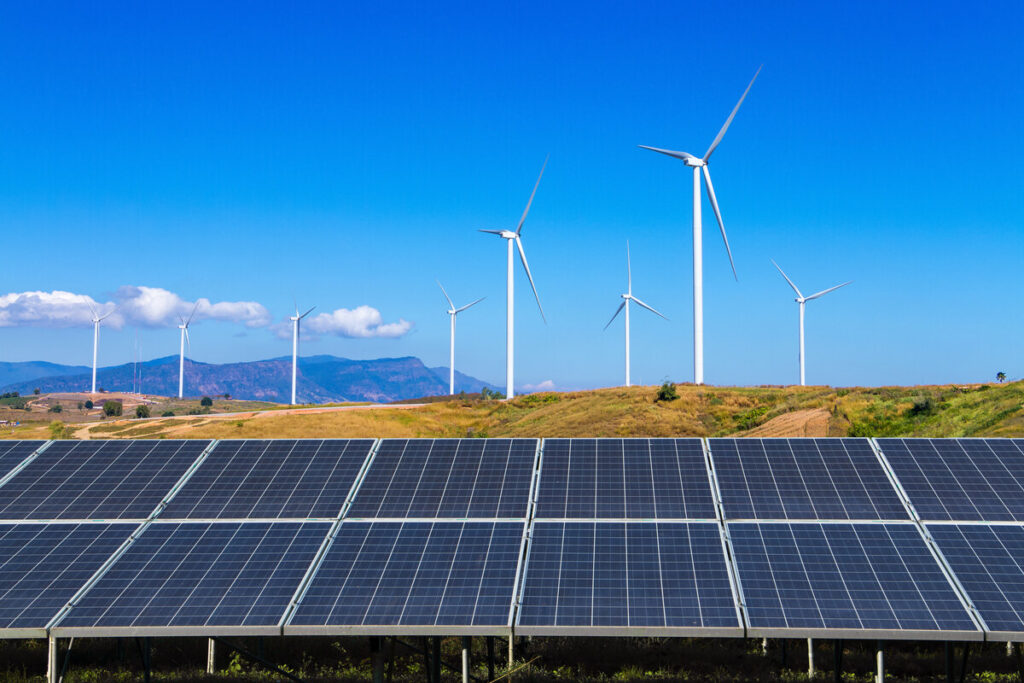
Solar panels, wind turbines and hydroelectric dams are all grouped under the same label, renewable energy. But they behave very differently once they are connected to a power grid, and those differences explain a lot about how the energy transition is actually unfolding.
What makes an energy source renewable
The International Energy Agency defines renewable energy as energy derived from natural processes that are replenished faster than they are consumed. Sunlight, wind and flowing water all fit that description, which is why they are usually discussed together.
That shared label hides an important point, though. Being renewable says where the energy comes from, not how reliably or how efficiently it can be turned into electricity. On those two questions, the three main sources have very different profiles.
Solar and wind: fast growing but intermittent
Solar and wind are the two sources that have grown the fastest. Global solar capacity grew by about 25% a year between 2014 and 2023, and wind by about 13% a year over the same period. In 2023, solar supplied 5.5% of the world’s electricity and wind 7.8%.
Part of that growth comes down to cost. Solar module prices have fallen by roughly 20% each time installed capacity doubles, a pattern known as Swanson’s law. Investment in solar nearly doubled between 2020 and 2022, from 162 to 308 billion dollars.
The trade-off is that both sources are intermittent by nature: output depends on how much sun or wind there is, and that varies from day to day and from month to month. A grid that relies heavily on them needs a way to cover the gaps.
Hydropower: steady and efficient, but limited by geography
Hydroelectricity works differently. With a global capacity of 1,267.9 GW, it supplied 14.3% of the world’s electricity in 2023, more than solar and wind individually. It also has a conversion efficiency of around 90%, the highest of any renewable source, and its output is stable rather than weather dependent from hour to hour.
Its limit is physical: it needs the right rivers and terrain. Only about a third of the estimated global potential of 14,000 TWh a year has been developed so far, and new projects often meet local opposition because they can displace communities and flood habitats.
How the two profiles work together
Hydropower also plays a second role that is easy to miss. Pumped-storage hydroelectricity, where water is pumped uphill when power is plentiful and released through turbines when it is needed, accounts for more than 85% of all grid electricity storage. In practice, it is currently the main tool for smoothing out the ups and downs of solar and wind.
Denmark shows how far a grid can already go. It generates more than 40% of its electricity from wind, and Spain, Portugal and Ireland each reach close to 20%. For comparison, solar and wind combined supplied only 10% of global electricity in 2021.
Common misconceptions worth clearing up
The first is that all renewables face the same technical constraints. As the numbers above show, a dam and a solar farm solve very different problems, which is why most grids use a mix rather than a single source.
The second is that renewable automatically means impact free. Bioenergy expansion, for example, has contributed to tropical deforestation in Brazil and Indonesia through demand for palm oil, and large hydro projects have real local consequences.
The third is that the obstacles are only about cost or technology. Fossil fuel subsidies, lobbying by incumbent energy suppliers and local opposition all slow deployment too.
Where things stand
Progress is measurable. Renewables rose from 20% to 28% of global electricity between 2011 and 2021, and reached 34% in 2025, with projections above 43% by 2030. At the 2023 UN climate conference, around three quarters of countries committed to tripling renewable capacity by 2030, although the current pace of expansion remains well below what that goal requires.
Understanding that solar, wind and hydropower each bring something different makes those headline figures easier to read: the question is less about which source wins, and more about how they are combined.