When people wonder whether humans are really behind climate change, the sun and volcanoes are usually the first suspects. They are reasonable ones: both have shaped Earth’s climate in the past. But the measurements gathered since the 19th century tell a fairly clear story about which factors are driving today’s warming, and which ones are not.
What the thermometers actually show
Regular global temperature records began in 1850. Since the industrial revolution, Earth’s average surface temperature has risen by about 1.5 °C. The decade from 2016 to 2025 averaged 1.26 °C above the pre-industrial baseline, and 2024 was the warmest year ever recorded, at 1.60 °C above it.
The question, then, is not whether the planet is warming, but what is pushing the temperature up.
Ruling out the usual natural suspects
The sun is the obvious first candidate, since it supplies almost all of the energy that reaches Earth. Yet solar radiation has shown no upward trend since 1880, the period during which most of the warming has been measured. A sun that is not getting stronger cannot explain a planet that keeps getting warmer.
Volcanoes are the second candidate, because eruptions release carbon dioxide. Here the numbers are just as telling: volcanic CO2 emissions amount to less than 1% of current human emissions. Both factors matter for the climate over the long run, but neither can account for the warming of recent decades.
What has changed: the air itself
The greenhouse effect works because certain gases in the atmosphere absorb infrared radiation, the heat that Earth’s surface gives off. Change the amount of those gases and you change how much heat stays near the surface.
That amount has changed considerably. The concentration of carbon dioxide in the atmosphere has risen by about 50% since 1750, reaching a level higher than at any point in the last 14 million years. In 2019, human activities released 59 billion tonnes of CO2 equivalent, made up of 75% carbon dioxide, 18% methane, 4% nitrous oxide and 2% fluorinated gases.
Why the warming has not been even larger
Two things have softened the curve. First, nature absorbs a large share of the extra carbon: roughly half of human CO2 emissions are taken up by land plants and the oceans. Land absorbs around 29% of annual emissions, and the oceans have absorbed between 20% and 30% over the past two decades.
Second, between 1750 and 1970, sulfur dioxide emissions formed sulfate aerosols that had a cooling effect, partly hiding the warming caused by greenhouse gases during that period.
A concrete example: the Arctic
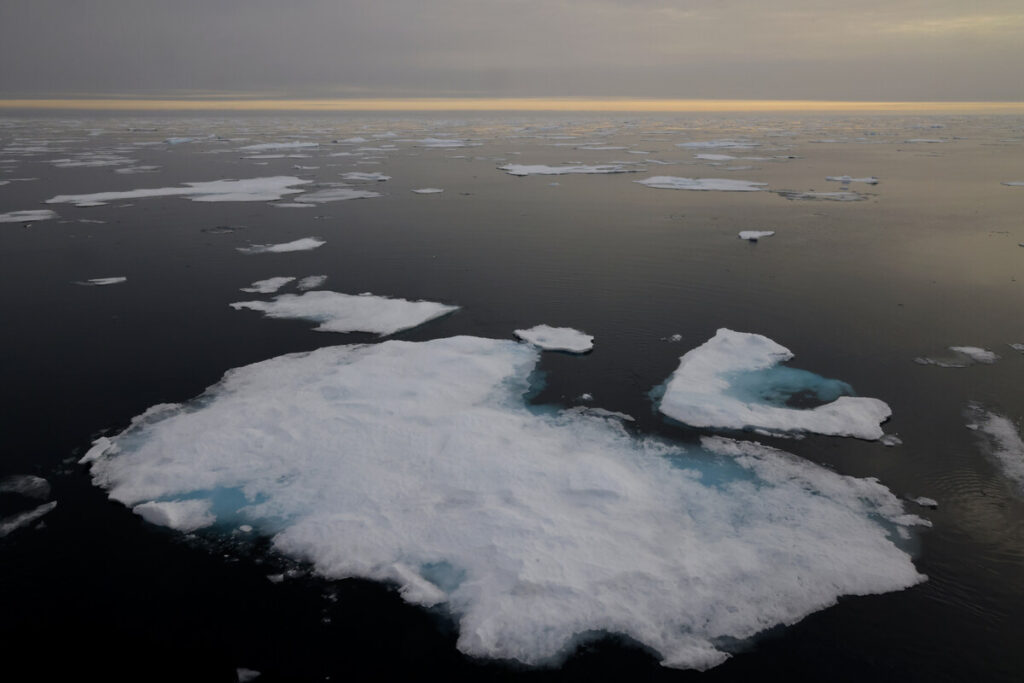
The Arctic is warming three to four times faster than the global average, and a simple mechanism helps explain why. Sea ice reflects 50% to 70% of incoming sunlight, while darker open ocean reflects only about 6%. When the ice melts, the ocean absorbs more heat, which in turn melts more ice. This feedback does not start the warming, but it amplifies it once it is underway.
Common misunderstandings
The climate has always changed
True, and sometimes dramatically: during the Last Glacial Maximum, about 20,000 years ago, the planet was 5 to 7 °C colder than today. What stands out about the current change is less its size than its speed, around 0.2 °C per decade, which is unusual compared with natural variations of the past.
All greenhouse gases work the same way
They do not. Their contribution depends on how concentrated they are, how long they stay in the atmosphere and how strongly they trap heat. Methane, for instance, stays in the air for about 12 years on average, far less than CO2, yet still accounted for 18% of emissions in 2019.
Current pledges already solve the problem
Not yet. With today’s commitments under the Paris Agreement, warming would reach roughly 2.8 °C by the end of the century, above the 2 °C limit the agreement aims for.
Looking ahead
According to the IPCC, the 20-year average temperature is expected to pass 1.5 °C in the early 2030s. Sea levels are currently rising by 4.8 cm per decade, and projections for this century range from 32 to 62 cm in a low-emission scenario to 65 to 101 cm in a very high one. That gap between scenarios is perhaps the most useful takeaway: the causes of today’s warming are well understood, which also means the factors that will shape what comes next are well identified.