Solar farms need space, and so does food. Agrivoltaics tries to stop treating them as rivals by putting panels and crops (or sheep) on the same piece of land. It sounds almost too neat, so how does it actually work, and where does it fall short?
What agrivoltaics means
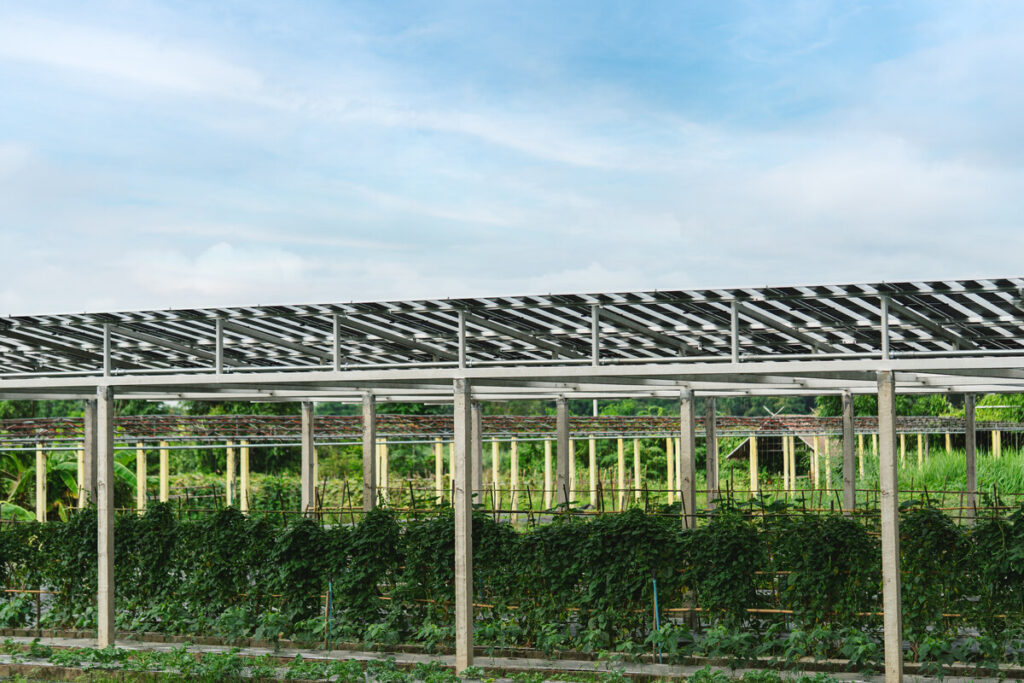
Agrivoltaics, also called agrisolar or dual-use solar, is simply the practice of using the same land for both solar energy and agriculture. Instead of choosing between a field of panels and a field of crops, the panels are raised, spaced out or mounted vertically so that farming can carry on underneath and between them.
The idea is older than it looks. Adolf Goetzberger, who founded Germany’s Fraunhofer Institute for Solar Energy Systems in 1981, theorised about this kind of dual land use with Armin Zastrow in 1982, precisely to ease the competition between solar power and crops. Akira Nagashima built the first prototypes in Japan in 2004, and the word “agrivoltaic” itself was coined by researcher Dupraz and his colleagues in 2011.
Why sharing a field can beat splitting it
The logic rests on a simple observation: many plants receive more sunlight than they can use. Panels catch part of that light for electricity, while the crops below still get enough to grow.
The early simulations by Dupraz and his team in 2011 estimated that combining the two could raise land use efficiency by 60 to 70% compared with dedicating separate plots to each, mostly because the sunlight falling on the field gets used twice.
Shade also changes the microclimate. Soil and crops under the panels stay cooler, and in Canada, lettuces grown under an agrivoltaic system stayed more than 20 °C cooler during a very hot summer.
A concrete example: water savings in the desert
The clearest gains so far come from hot, dry places. In a California desert, shading from solar panels cut evaporation by 14 to 29% for irrigated cucumbers and lettuce, two crops that tolerate shade well. Research in the Arizona desert found water savings of up to 50% for certain crops, and Australian trials showed that condensation forming under the panels can help keep grass watered.
Livestock works too. Solar grazing, which took off in Britain in the 2010s, usually relies on sheep: they get forage and shade, and renting them is often cheaper than mowing the grass between panels. Studies found spring lamb production similar to open pastures, and one life-cycle analysis of a pasture-based system reported 69.3% fewer greenhouse gas emissions than producing the food and the energy separately.
Where it gets more complicated
Not every crop likes shade
Leafy greens and spices such as turmeric and ginger can benefit from partial shade, but staple crops like wheat, rice, soybeans and pulses need more sun. Wheat in particular yields less in low light, so the crop choice matters as much as the panels.
Climate changes the picture
In northern climates, the extra humidity under panels can encourage plant disease and lead to more pesticide use, with no clear net benefit. The water advantage seen in deserts does not travel everywhere.
Cost and practicality
The cost of installing the panels is the single biggest factor in whether a project makes economic sense. Farmers also need structures high enough, or rows wide enough, for tractors to pass, plus electrical connections, insurance and specialised maintenance. Some land is still lost to mounting structures, and many farmers remain unsure about yields, markets and compensation.
Where agrivoltaics is heading
Growth is uneven. By 2020, around 2.8 gigawatts of agrivoltaics had been installed worldwide, and nearly 70% of it was in China, where projects grow tomatoes and goji berries alongside panels. Since 2023, China has banned solar installations on arable farmland and grasslands, steering projects toward arid desert areas instead.
Public opinion seems receptive: in one US survey, 81.8% of respondents said they would be more likely to support solar in their community if it also produced food. Agrivoltaics will not suit every field or every crop, but where shade, water and the right plants line up, it offers a practical way to grow renewable energy without taking land away from more sustainable farming.