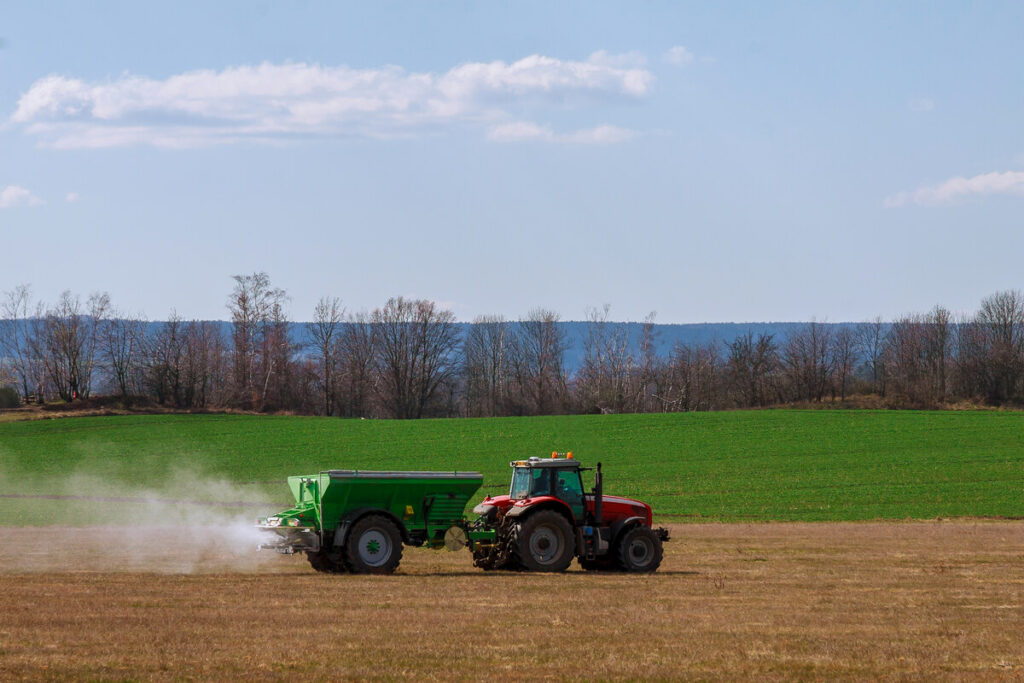
Mention greenhouse gases and most people think of carbon dioxide, maybe methane. Nitrous oxide rarely comes up, even though it is the third most important greenhouse gas and most of the human share comes from farm fields. So what is it, and why does it matter for the climate?
A small gas with a long reach
Nitrous oxide (N2O), better known outside climate science as laughing gas, is one of the five most abundant greenhouse gases, alongside water vapor, carbon dioxide, methane and tropospheric ozone. Like them, it absorbs the infrared radiation given off by the Earth’s surface and sends part of it back down, keeping heat in the climate system.
What makes it stand out is its strength. Molecule for molecule, nitrous oxide traps around 265 to 273 times more heat than CO2 over 100 years, depending on which IPCC assessment you use. It also lingers: its average atmospheric lifetime is more than a century, far longer than the roughly 12 years of methane.
The reason it gets less attention is volume. Its concentration is less than a thousandth of carbon dioxide’s, so its total contribution to the greenhouse effect is less than a third of CO2‘s, and smaller than methane’s.
Where it comes from: soil bacteria do most of the work
Nitrous oxide is part of the natural nitrogen cycle. Soils under natural vegetation, the oceans and chemical reactions in the atmosphere all release it. About 40% of today’s emissions are caused by human activity, and the mechanism behind most of that share is surprisingly biological.
In soil, bacteria transform nitrogen in two main ways. Nitrification turns ammonia into nitrite and then nitrate, in the presence of oxygen. Denitrification runs in the other direction when oxygen is scarce, reducing nitrate step by step to nitrogen gas, with nitrous oxide as one of the intermediate products. Whenever more nitrogen is added to a field, through synthetic fertilizer or manure, these microbes have more raw material to work with, and some of it escapes as N2O.
How much escapes depends on soil type, acidity, temperature, moisture and the amount of available nitrogen and organic matter. Emissions are also very uneven: much of a year’s output can happen during short “hot moments” and in specific “hotspots” rather than steadily across a field.
The numbers behind the human share
The breakdown of human-caused emissions shows clearly where the gas comes from:
- Fertilized agricultural soils and livestock manure: 42%
- Runoff and leaching of fertilizers: 25%
- Biomass burning: 10%
- Fossil fuel combustion and industrial processes: 10%
- Breakdown of other nitrogen-containing emissions: 9%
- Human sewage: 5%
In other words, around two thirds of the human share is linked directly to fertilizers and manure. On the industrial side, the production of nitric acid and adipic acid are the largest sources.
The result is visible in the atmosphere. Concentrations rose from about 270 parts per billion in 1750 to 339 ppb in 2025, an increase of more than 20%, and growth of roughly 1 ppb per year has accelerated in recent decades. In its 2022 assessment, the IPCC identified human disruption of the nitrogen cycle as the largest driver of the 10% rise recorded between 1980 and 2019.
What people often get wrong
The first misconception is that nitrous oxide is a minor issue because it is rarely in the headlines. In absolute terms, human emissions of the gas have a warming effect equivalent to about 3 billion tonnes of CO2 a year. That is small next to the 37 billion tonnes of carbon dioxide emitted in 2019, but in the same league as methane, at around 9 billion tonnes of CO2 equivalent.
The second is that it is only a climate problem. Nitrous oxide also damages the ozone layer: a 2009 study found that it had become the single most important ozone-depleting emission, and was likely to remain so through the 21st century.
The third is that there is a simple fix. Farmers can use nitrification inhibitors, compounds that slow the conversion of fertilizer nitrogen in the soil. They are usually effective at helping crops recover more of the nitrogen applied, but their benefits depend on local conditions, and they are not a universal switch that turns emissions off.
Why it is worth knowing about
Nitrous oxide is a reminder that the climate story is not only about smokestacks and exhaust pipes. A large part of it plays out underground, in the way nitrogen moves between fertilizer, soil, microbes and the air. Keeping more of that nitrogen in the soil and out of the atmosphere is one of the quieter, but very real, challenges of climate action.