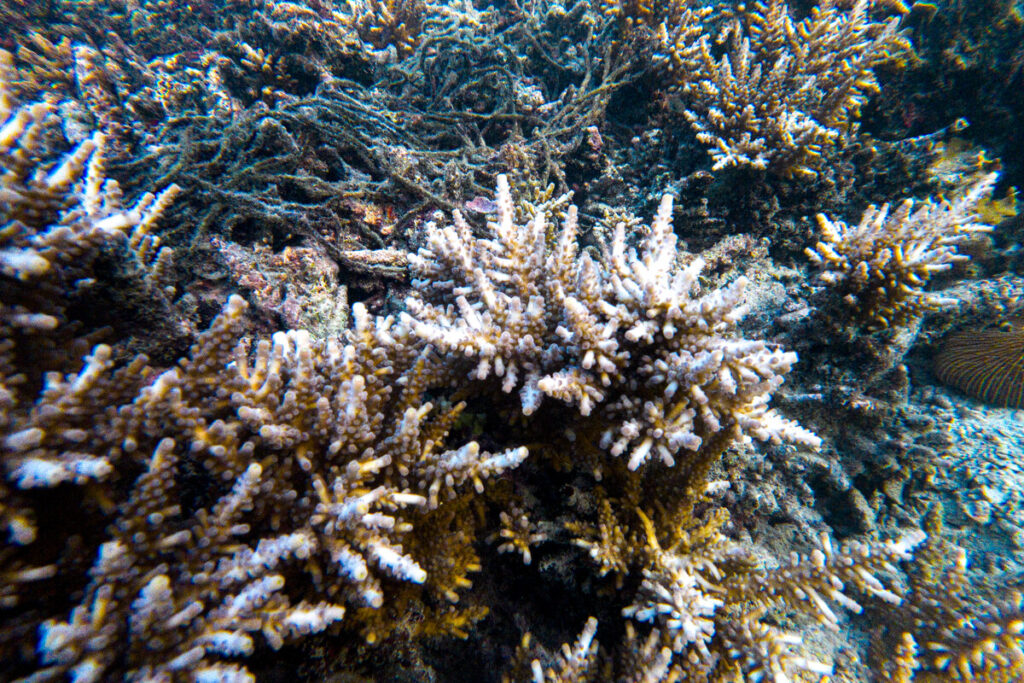
A white coral looks like a dead one, but bleaching is closer to a broken partnership than a funeral. The coral has lost the algae that feed it, and what happens next depends on how long the stress lasts.
What is actually happening inside a bleached coral
Reef-building corals live in a partnership with microscopic algae called zooxanthellae, which sit inside the coral’s tissue. The algae photosynthesize, and in exchange for the carbon dioxide and ammonium the coral provides, they supply up to 90 percent of the coral’s energy needs.
When conditions turn stressful, the coral expels or consumes its algae. The most common trigger is unusually warm water, but changes in light, salinity or nutrients can do it too. Without the pigmented algae, the white skeleton shows through, hence “bleached”. Some corals even turn bright blue, pink, purple or yellow instead: under mild stress they make sunscreen-like pigments, a phenomenon called colourful bleaching.
Bleached does not mean dead
Coral can survive short-term disturbances. To recover, the algae have to move back into the coral polyps and restart photosynthesis. If the stress continues, the polyps starve and die, and the bare skeleton is often taken over by ordinary algae that block new coral from settling. Over time the skeleton erodes and the reef structure collapses.
Outcomes vary a lot. Large, sturdy colonies such as Porites can take extreme temperature shocks, while fragile branching corals such as Acropora are far more vulnerable. Local conditions matter as well: a patch of shade or a stream of cooler water can reduce bleaching on one part of a reef and not on the next.
A real-world test: the Seychelles after 1998
In 1998, bleaching wiped out more than 90 percent of the corals around the Seychelles. A later study of 21 reefs there (Graham et al., 2015) found that about half recovered, while roughly 40 percent shifted to reefs dominated by macroalgae. Factors such as the density of juvenile corals and the reef’s original structural complexity helped predict which way a reef would go.
Why it is happening more often
Heat is the main driver. The US National Oceanic and Atmospheric Administration (NOAA) flags “hot spots” where sea surface temperature runs 1 °C or more above the long-term monthly average, and its Coral Reef Watch tracks 190 reef sites by satellite. The IPCC’s Sixth Assessment Report summed up the trend: “Since the early 1980s, the frequency and severity of mass coral bleaching events have increased sharply worldwide.”
The fourth global bleaching event, confirmed by NOAA in April 2024, shows the scale. Between 1 January 2023 and 30 September 2025, bleaching-level heat stress affected about 84.4 percent of the world’s coral reef area, and bleaching was documented in at least 83 countries and territories.
Nuances worth knowing
Bleaching is one pressure among several. On the Great Barrier Reef, the 2016 event killed an estimated 29 to 50 percent of the reef’s coral. Yet an analysis of the whole 1985 to 2012 period found a 50.7 percent decline in coral populations, with only about 10 percent of it attributed to bleaching. The rest came from tropical cyclones and crown-of-thorns starfish in roughly equal parts.
There are also reasons researchers keep studying resilience. Corals around Ofu Island in American Samoa endure a sharp temperature spike for about four hours every low tide without bleaching or dying, and scientists are asking whether corals elsewhere could be conditioned in a similar way. Local stressors such as sediment runoff or certain sunscreen ingredients matter too: Hawaii banned sunscreens containing oxybenzone and octinoxate from January 2021.
So a white reef is a warning sign, not a verdict. Each bleaching event raises the same question: does the heat ease soon enough for the algae to return?