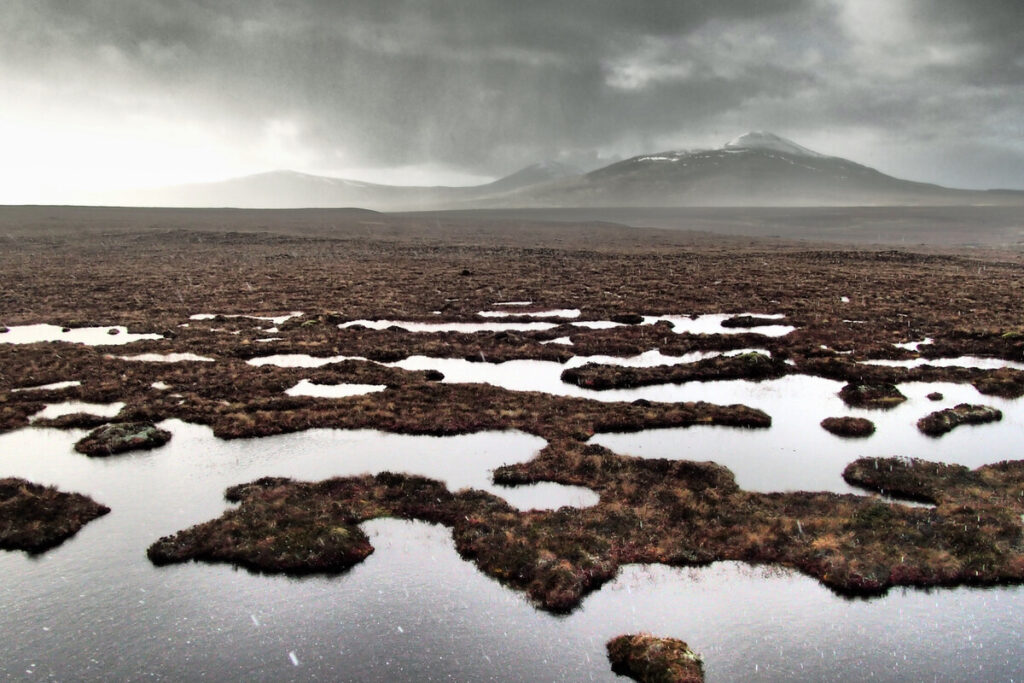
Peat bogs can look like wet, empty ground, but they hide one of the largest carbon stores on land. Here is why this slow-growing soil matters far more than its size suggests, and what changes when a peatland is drained.
What peat actually is
Peat is plant material that has only partly decayed. It builds up in waterlogged, acidic places with almost no oxygen, where decomposition slows to a crawl. Sphagnum moss, a common peat builder, helps keep the ground wet by holding water in special cells and releasing tannins that preserve dead plant matter. The result is a landscape that slowly thickens itself.
A small area with a huge store
Peatlands cover roughly 3% of the world’s land surface, yet they hold up to 550 gigatonnes of carbon, about 42% of all soil carbon. That is more than the carbon in all the world’s forests combined. Northern peatlands alone store around 415 gigatonnes, roughly 46 times the world’s CO2 emissions in 2019. Tropical peatlands, in places like Indonesia and the Congo basin, add about 50 gigatonnes.
The reason is timing. Peat grows at about a millimetre a year, and most northern bogs began forming around 12,000 years ago, after the last ice age. A typical boreal peatland holds a layer 1.5 to 2.3 metres deep, which took thousands of years to build.
What happens when peat is drained
Peat stays a carbon store only while it stays wet. When canals drain a peatland for farming, forestry or extraction, the buried carbon meets the air and decomposes into carbon dioxide. About 12% of the world’s peatlands have been drained and damaged, and as of 2022 they were estimated to emit around 4% of human-made greenhouse gases, not counting fires.
Fires are the second risk. Peat fires can smoulder underground for months, years or even centuries, and a light rain will not put them out. In 1997, fires in Indonesia’s peat and forests released an estimated 0.81 to 2.57 gigatonnes of carbon, equal to 13 to 40% of that year’s emissions from burning fossil fuels. In June 2019, peat fires in the Arctic emitted about 50 million tonnes of CO2, similar to Sweden’s annual emissions.
Nuances worth knowing
Peat is sometimes called a renewable fuel, but it regrows far slower than it is harvested, and in Finland burning it releases about 106 grams of CO2 per megajoule, more than coal (94.6) or natural gas (56.1). Peat is not only a climate story, either. In the UK, about 43% of people get drinking water from peatland catchments, and bogs shelter cranes, orchids and carnivorous plants. Even fire is not always the enemy: some bog plants depend on occasional burns to keep woody competition in check.
Restoration offers a hopeful note. Once drained sites are re-wetted and plants are reintroduced, typical plant communities return within about five years, followed by insects and birds, and pools add habitat variety. Gardeners can join in too: peat-free potting mixes based on bark or coir are growing in popularity, and Chile has banned extraction since April 2024.
The takeaway: a peatland is less a patch of mud than a thousand-year-old carbon vault, and the key to keeping it shut is simply keeping it wet.