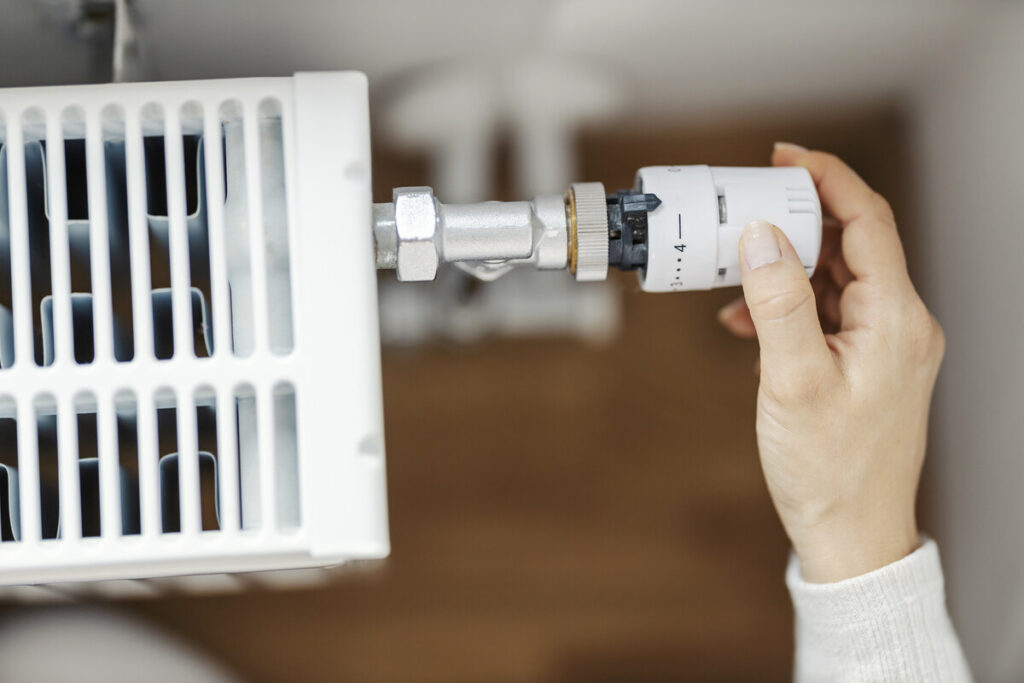
That small dial on the side of a radiator is not a power knob. It is a self-regulating valve that decides, room by room, how much hot water gets in, and it only works well if it can sense the air around it.
What a thermostatic radiator valve is
A thermostatic radiator valve (TRV) is a self-regulating valve fitted to a radiator in a hot-water heating system. It controls the temperature of a room by changing the flow of hot water into the radiator. When the room is cold, the valve stays open and the radiator heats up. As the room warms, the valve closes gradually and the radiator receives less hot water.
How the classic version works
Inside a conventional TRV sits a plug, typically made of wax, known as a wax motor. The wax expands as the surrounding air warms and contracts as it cools. The plug pushes on a pin connected to the valve, so a warmer room means a more closed valve. This lets you set a maximum temperature for each room instead of running every radiator flat out.
It also explains the most common mistake. The valve senses the temperature of the air around it, so anything that traps heat close to it, such as a heavy curtain draped over the head, can make it “think” the room is warmer than it is and shut off too early. Interestingly, if the control head is removed altogether, the valve simply opens fully.
Why the numbers are not degrees
Many TRVs are marked 1 to 5 rather than in degrees Celsius. That is because each valve varies slightly in manufacturing, and nobody knows in advance the size of your room, how well it is insulated or how hot the radiator water is. So it is impossible to predict exactly what temperature each setting will give. Broadly, manufacturers assume that 3 gives a comfortable temperature. The practical approach is to try a setting, wait, and adjust.
What it can save
Replacing a manual radiator control with a conventional wax TRV has been estimated to save at least 280 kilograms of CO2 per year. That estimate dates from 2011 and refers to a three-bedroom semi-detached house in Britain with gas heating, so it is an example rather than a promise for every home. TRVs can also reduce heating bills by up to 17 percent a year, because they use heat only when it is needed.
The one place to be careful
TRVs and a room thermostat can work against each other. If a TRV sits in the same room as the thermostat that controls the boiler and is set lower, it may close the radiator before the thermostat is satisfied. The boiler then keeps running, and the rest of the house can become uncomfortably warm if the other radiators have no valves. If both are set to the same temperature, behaviour can be unpredictable. The usual advice is to set the TRV higher than the room thermostat in that room.
Smart valves and balanced systems
Since around 2012, electronic TRVs, sometimes sold as smart TRVs, have become more common. They can be programmed or remote-controlled per radiator, respond to occupancy, and use a sensor placed away from the radiator for a more relevant reading. Some run on batteries that need replacing, and some need an app or a smart home hub using protocols such as Zigbee or Z-Wave.
A related idea is hydronic balancing. In a heating system, circuits close to the pump tend to receive more flow than they need while others get too little. Balancing limits the flow in the favoured circuits so every radiator gets the right amount of water. In a small domestic system this can often be done by simply presetting the flow through each radiator, and it means the pump does less unnecessary work and rooms reach the set temperature sooner.
The takeaway: a radiator valve is a sensor and a throttle in one. Keep its head uncovered, treat the numbers as a scale rather than a temperature, and it will quietly do its job.