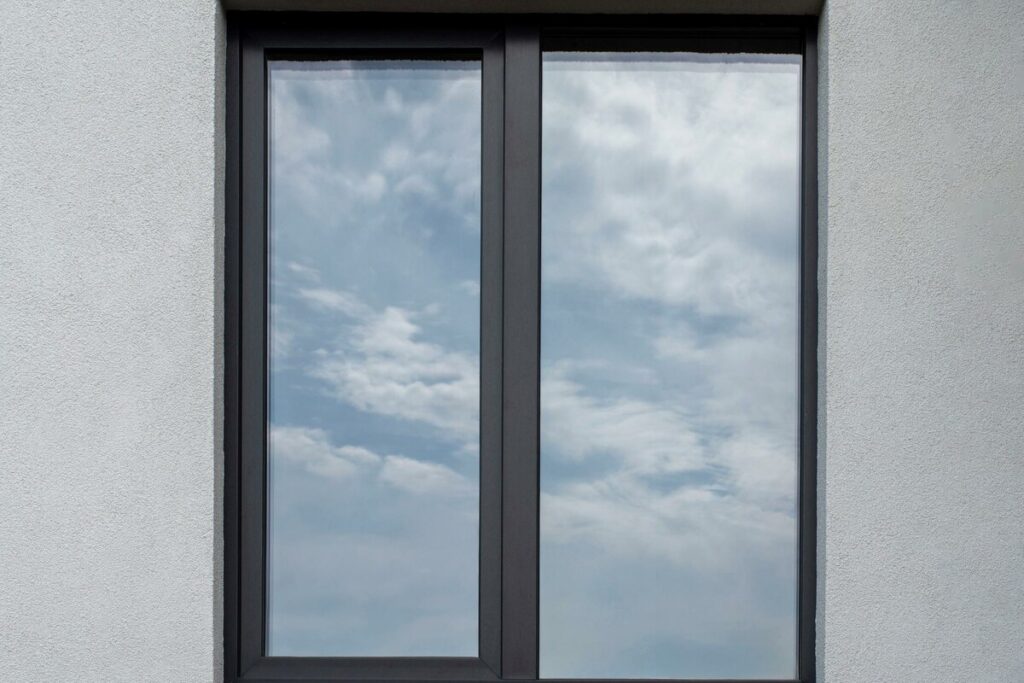
A double-glazed window does not insulate because it has two sheets of glass. Most of the benefit comes from the sealed space between them, and from what is in it and on it.
What is really inside a double-glazed unit
An insulating glass unit (IGU) is two or more panes separated by a gap that reduces heat transfer through the building envelope. The same idea gives us triple and even quadruple glazing. The glass itself is a poor insulator: a single pane has an R-value of around 1, so on its own it offers very little resistance to heat flow. As the source material puts it, the space in between the panes provides the bulk of the insulation effect.
The idea is older than most people think. A sealed unit was patented in the United States by Thomas Stetson in 1865, and it became a commercial product in the 1930s and 1940s under the Thermopane brand name, which has since become a generic word for any IGU.
Four details that do the heavy lifting
- The gap: most sealed units reach their best insulating value with a space of about 16 to 19 mm. Wider is not better, because beyond a point convection currents start carrying heat between the panes.
- The fill gas: argon conducts heat at about 67% of the rate of air, which is why it is common, and krypton conducts about half as much as argon. Krypton is far more expensive, so it is mostly kept for very thin units or high-performance triple glazing.
- The coating: low emissivity (low-E) glass carries a thin, mostly metallic coating that reflects infrared light. It can cut solar gain and improve thermal performance at once.
- The spacer: the strip that separates the panes can itself leak heat. Metal spacers conduct heat, so “warm edge” spacers made of less conductive materials such as structural foam are used to reduce that loss and the condensation that can form at the edge.
A concrete example: how the R-value stacks up
A standard clear unit with air in the cavity has an RSI value of about 0.35 K·m²/W. A rule of thumb in the US system is that each improvement to a component adds roughly one R-value point. Adding argon takes a unit to about R-3, and adding low-E glass on the second surface adds another point. A well-designed triple unit with low-E coatings and argon in both cavities does better still. These figures describe the centre of the glass, and the frame also matters in a real window.
Common misunderstandings
More panes are not always the answer. Triple glazing adds thickness and weight, and the source notes that this makes units unwieldy for most residential and commercial frames, especially in opening sashes. Vacuum insulated glass removes the convection problem, but it needs tiny pillars to hold the panes apart, and early designs of the 1990s were no better than a good double-glazed unit.
Another surprise is that not every gas is a green choice. Sulfur hexafluoride has been offered as a fill gas, partly for sound proofing, but it is an extremely potent greenhouse gas. In Europe it falls under the F-Gas directive, which controls or bans many of its uses.
Seal failure and what it means for lifespan
Sealed units do not last forever. They typically last 10 to 25 years, and windows facing the equator often last less than 12 years. When the perimeter seal fails and the desiccant is saturated, moisture collects between the panes, and that can generally only be fixed by replacing the unit. Large temperature differences between the inner and outer panes stress the adhesives, and units with a small gap are more prone to failure. Some companies in Canada, the UK and Ireland offer to restore failed units by venting them, which often clears the visible condensation. The trade-off is a lower insulating value, though it can be a reasonable option when the window is otherwise in good condition.
The takeaway
Double glazing works because of a carefully engineered sandwich: a gap of the right size, a low-conductivity gas, a reflective coating and an edge that does not leak heat. Knowing which of those parts a window actually has makes it much easier to compare one window with another.