Tiny houses have become a symbol of living lighter: fewer belongings, smaller bills, a smaller footprint. The energy numbers really are striking, but whether a tiny house is a sustainable choice depends on more than its floor area.
What counts as a tiny house
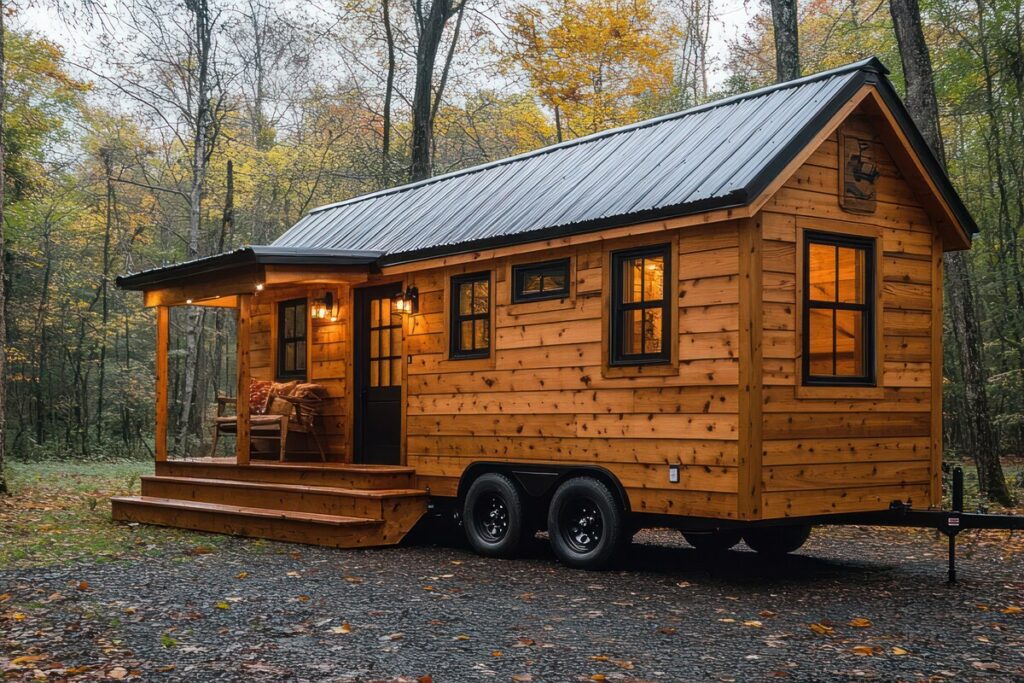
There is no single standard. The International Residential Code, used widely in the United States, defines a tiny house as 400 square feet (37 m²) or less of floor area, not counting lofts. Merriam-Webster stretches the definition to 500 square feet. Some tiny houses sit on a foundation, others are built on trailers, usually under 8 by 20 feet, so they can be towed.
The idea grew partly as a reaction to ever larger homes. The average new American house went from 1,780 square feet in 1978 to 2,662 square feet in 2013, so a 400 square foot tiny house is about 15 percent of that size. Writers such as Lloyd Kahn (Shelter, 1973), Lester Walker (Tiny Houses, 1987) and Sarah Susanka (The Not So Big House, 1997) helped shape the movement, and in 1999 Jay Shafer built a 90 square foot mobile home and founded the Tumbleweed Tiny House Company. It also fits into a much older tradition of voluntary simplicity, going back to Thoreau’s Walden.
Why a smaller home uses so much less energy
The logic is simple: less space means less to heat, cool, light and maintain. A 2015 analysis by Kaufmann, cited in the Wikipedia overview of the movement, put numbers on it. A tiny house used about 914 kWh of energy a year and produced around 1,144 pounds (0.5 tonnes) of CO2, compared with about 12,733 kWh and close to 16,000 pounds (7.3 tonnes) for an average house. That is roughly 7 percent of the energy of a typical home.
Small homes also make some technologies easier to use. Many tiny houses run on rooftop solar, and falling prices for solar panels and batteries make living off the grid more feasible. Some use compost toilets instead of flushing, and one Texas group builds with recycled materials rather than new ones.
Where the picture gets more complicated
Cheaper overall, but not per square foot
The national median cost of a tiny house in the United States was $60,000 in 2019, far below a typical home. But tiny houses can cost more per square foot than regular houses, and buying or renting land can still make the total expensive. Smaller homes do mean lower taxes, heating, maintenance and repair costs over time.
The rules often were not written for them
Zoning codes frequently set minimum house sizes larger than a tiny house, and camping rules can forbid living on wheels on private land. The Recreation Vehicle Industry Association states that “Tiny houses on wheels are considered RVs and are not suitable for permanent residence.” Some places have adapted: Spur, Texas, declared itself the first “tiny-house friendly town” in 2014, and Edmonton removed its minimum width rule for houses in 2019.
Tiny houses have been getting bigger
The movement itself has drifted. Many newer models are larger, heavier and pricier than the early ones, which moves them away from the original goal of a reduced environmental impact. Tiny living also does not suit everyone: critics point to overcrowding for families, accessibility challenges for older or disabled residents, limited storage and little room to host guests.
Still a niche
Even during the Great Recession, which gave the idea a boost, only around 1 percent of home buyers bought a tiny home. As Eve Andrews put it in Grist, “You’re more likely to encounter one while scrolling through $300-a-night Airbnb listings than browsing Zillow.” Interest is high, though: a 2024 Fidelity survey found that 73 percent of Americans would consider living in one, mainly for affordability and minimalism.
What the tiny house idea teaches, even if you never live in one
The clearest lesson from tiny houses is not about trailers or lofts. It is that the size of a home is one of the biggest drivers of how much energy it uses. A tiny house is one way to act on that, and it can work very well for some people. For others, the same principle shows up in quieter forms: a smaller home, an accessory unit for a relative, or simply using the space you have more efficiently. The sustainable part is less the label than how much space, and energy, a household actually needs.