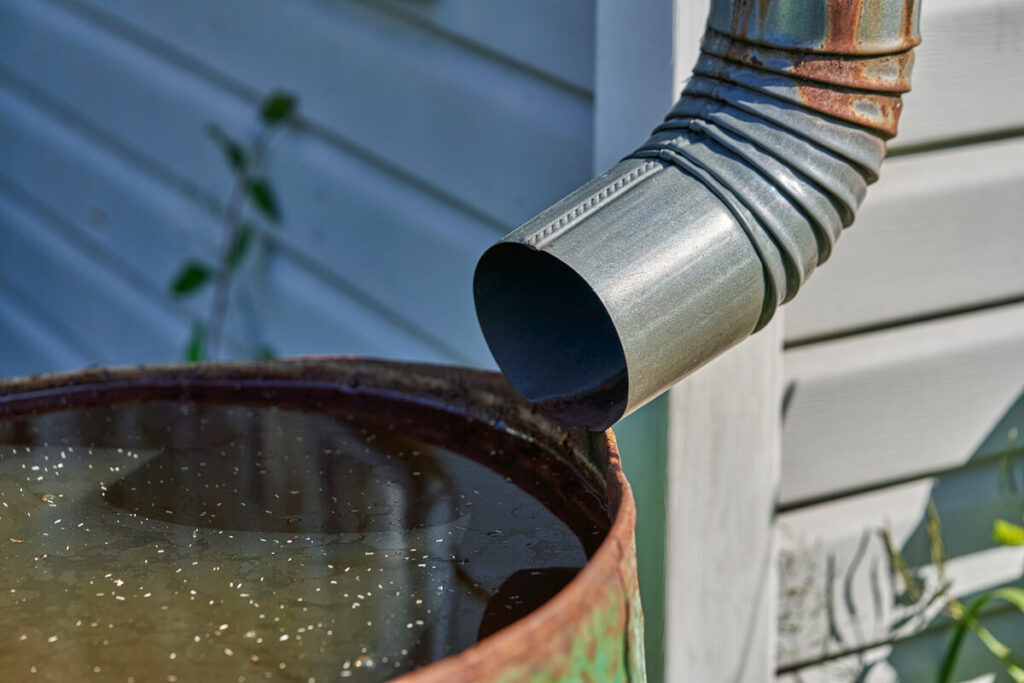
Rainwater harvesting often brings to mind a single barrel under a gutter, used to water the tomatoes. In reality it is one of the oldest water systems humans have built, and today it supplies everything from rural households to an Olympic venue. Here is what it covers, how it works, and why rain that falls clean doesn’t always stay that way.
What rainwater harvesting actually means
At its simplest, rainwater harvesting is the collection and storage of rain instead of letting it run off. Water is gathered from a roof-like surface and directed into a tank, a cistern, a well or borehole, or a reservoir that lets it seep down and recharge the groundwater below.
It is usually distinguished from stormwater harvesting, which captures runoff from the ground and paved areas. Rainwater systems mostly rely on roofs. Once collected, the water can be used for gardens, livestock and irrigation, for household needs with proper treatment, for long-term storage, or simply to top up local aquifers.
Systems can serve a single home, a neighbourhood, a whole community, or institutions such as schools and hospitals.
How a typical system works
A basic setup is more of a plumbing job than a high-tech one. The outlets from a roof are connected through pipes to a storage tank, often underground. Common components include gutters and drains, a pre-filter (such as a vortex filter) to keep out leaves and sediment, and the storage container itself. Pressurised systems add pumps, and drinking-water systems add treatment such as UV lights, chlorination or post-filtration.
Sizing is the key design question. Ideally, the system should cover water demand through the dry season, which means the roof must be large enough to capture an adequate flow, and the tank large enough to hold it.
An old idea with some impressive modern examples
Storing rain is far from new. Waterproof lime plaster cisterns were built into the floors of Neolithic homes in the Levant, and a cistern carved from solid rock around 2500 BC at Khirbet et-Tell held nearly 1,700 cubic metres. Venice, surrounded by a brackish lagoon, depended on rainwater for centuries: water percolated through specially designed stone paving, was filtered by a layer of sand, and collected at the bottom of public wells.
Modern versions work at very different scales:
- Thailand has the largest share of its rural population relying on rainwater, around 40%. After government funding for tanks ended in the 1990s, the private sector supplied several million tanks to households, many still in use today.
- Bermuda requires by law that all new construction include rainwater harvesting adequate for its residents.
- New Zealand treats it as normal practice in many rural areas, with roof water directed into covered 1,000 litre tanks.
- At the London Olympic Park, rainwater harvesting at the Velodrome was estimated to cut the building’s potable water demand by 73%.
The nuances people often miss
Clean rain, not always clean water
Rain itself is a clean source, often better than groundwater or river water. The trouble starts with collection and storage. Roof water can pick up bird and animal droppings, mosses, windblown dust, urban particles, pesticides and dissolved gases. In Europe, pesticide levels have been found to be highest in the first rain after a dry spell.
Simple design choices help a lot. Diverting the first flush of runoff to waste significantly reduces contaminants, and drawing water from a floating intake rather than the bottom of the tank also improves quality. Still, harvested rain should only be drunk after proper treatment, such as boiling. Open cisterns can also become breeding sites for mosquitoes, so tanks need to be sealed against them.
Not always the best investment
Even a strong result doesn’t make rainwater the automatic winner. At the Olympic Park, the Velodrome system was judged a less efficient use of money for improving sustainability than the park’s blackwater recycling programme. Life cycle studies also find that a building’s dimensions and function strongly shape how much environmental benefit a system delivers. And in arid regions, harvests can be minimal in years of below-average rainfall.
Maintenance matters too. In Uganda, where rainwater has long supported household water security, many installations have failed simply because they were not kept up.
Matching the water to the job
Perhaps the most useful idea behind rainwater harvesting is a simple one: water quality can be matched to its use. In most of the developed world, treated drinking water is used for everything, including flushing toilets and watering lawns. Lightly filtered rainwater can cover many of those tasks, easing pressure on public supplies and reducing stormwater in sewers. It won’t replace the tap, but used in the right place, it quietly makes every drop of treated water go further.