For many people, climate change and the hole in the ozone layer are part of the same story: something is letting more heat in through a gap in the sky. It’s an intuitive picture, and a common enough confusion that global warming has often been perceived as a mere subset of the “ozone hole”. In reality, they are two separate problems with different causes, but they do touch each other in a few surprising ways.
What the ozone layer actually does
Ozone (O3) is a form of oxygen made of three atoms instead of two. In the stratosphere, high above the weather, it is constantly formed and broken apart by sunlight. Its key role is protective: ozone is the only gas in the atmosphere that absorbs UVB light, the ultraviolet wavelengths linked to sunburn, skin cancer and cataracts, and that can also harm plants and animals.
So the ozone layer is mainly about ultraviolet radiation reaching the ground. Global warming, on the other hand, is about greenhouse gases such as carbon dioxide trapping heat that the Earth would otherwise radiate back to space.
How the ozone hole formed
The main culprits are manufactured chemicals that were once everywhere: chlorofluorocarbons (CFCs), halons and related compounds used in refrigerators, aerosol sprays, solvents, foams and fire extinguishers. Because they barely react in the lower atmosphere, they drift intact up to the stratosphere. There, ultraviolet light breaks them apart and releases chlorine and bromine atoms.
These atoms act as catalysts: they destroy ozone and come out of the reaction unchanged, ready to start again. A single chlorine atom reacts with around 100,000 ozone molecules on average before it is finally taken out of the cycle.
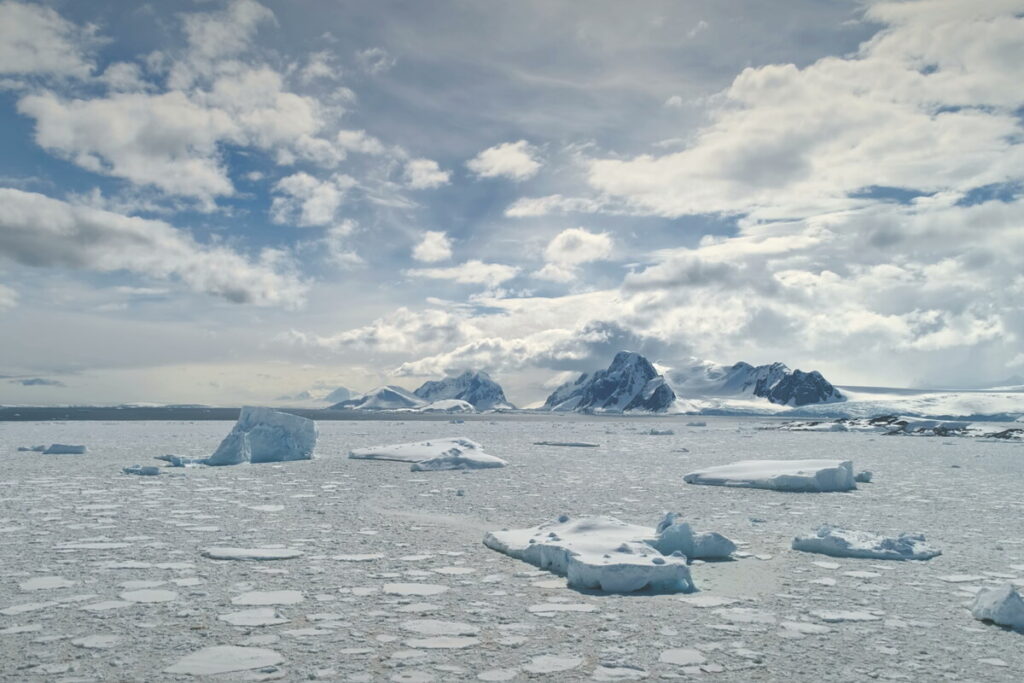
The damage is most dramatic over Antarctica each spring, from September to early December. During the dark polar winter, temperatures in the stratosphere fall to around −80 °C and special clouds form. Their ice particles turn harmless chlorine compounds into reactive ones, and when sunlight returns, ozone is destroyed fast. At its worst, ozone over Antarctica has dropped to about a third of its pre-1975 level. The hole sits there not because more CFCs end up over the South Pole (they are well mixed around the globe) but because of that extreme cold.
Even the word “hole” is a little misleading. It is better described as a seasonal dip in ozone levels than as an actual gap, and outside the polar regions the decline has been much smaller, around 4 to 5 percent at middle latitudes.
Where ozone and climate really connect
The two issues are not the same, but they are not completely unrelated either. There are three main links.
Many ozone-destroying chemicals are also greenhouse gases
Some of these compounds trap heat thousands of times more effectively than carbon dioxide over the short and medium term. The rise in their concentrations has produced about 14 percent of the total warming effect of well-mixed greenhouse gases, a similar idea to the one behind methane’s outsized short-term impact.
The hole itself slightly cools the surface
Counterintuitively, losing ozone has a small net cooling effect on the climate rather than a warming one. The IPCC estimated it at about −0.15 watts per square metre, a modest figure compared with the warming from greenhouse gases.
Global warming can make ozone loss worse
The same carbon dioxide that warms the surface also cools the stratosphere. A colder stratosphere is expected to favour those polar clouds and, with them, more ozone destruction at the poles.
A success story with a climate bonus
In 1987, 43 nations signed the Montreal Protocol to phase out CFCs and related chemicals, with controls taking effect from 1989. It is widely considered the most successful international environmental agreement to date. According to a 2023 United Nations assessment, the ozone layer is on track to return to 1980 levels around 2040 for most of the world, 2045 over the Arctic and 2066 over Antarctica, provided current rules stay in place. Year-to-year swings still happen: in 2023 the Antarctic hole was one of the largest on record, possibly linked to the 2022 Tonga volcanic eruption.
Because so many of the banned substances were also powerful greenhouse gases, protecting the ozone layer has helped the climate too. There is a nuance, though: some replacements, such as the HFC-134a long used in car air conditioners, don’t harm ozone but are still potent greenhouse gases, which is why newer cars increasingly use refrigerants with a much lower warming potential. And one ozone-depleting gas was never covered by the treaty: nitrous oxide, now the largest ozone-depleting emission.
The ozone story shows that the two problems are distinct, but also that solving one can quietly help with the other.