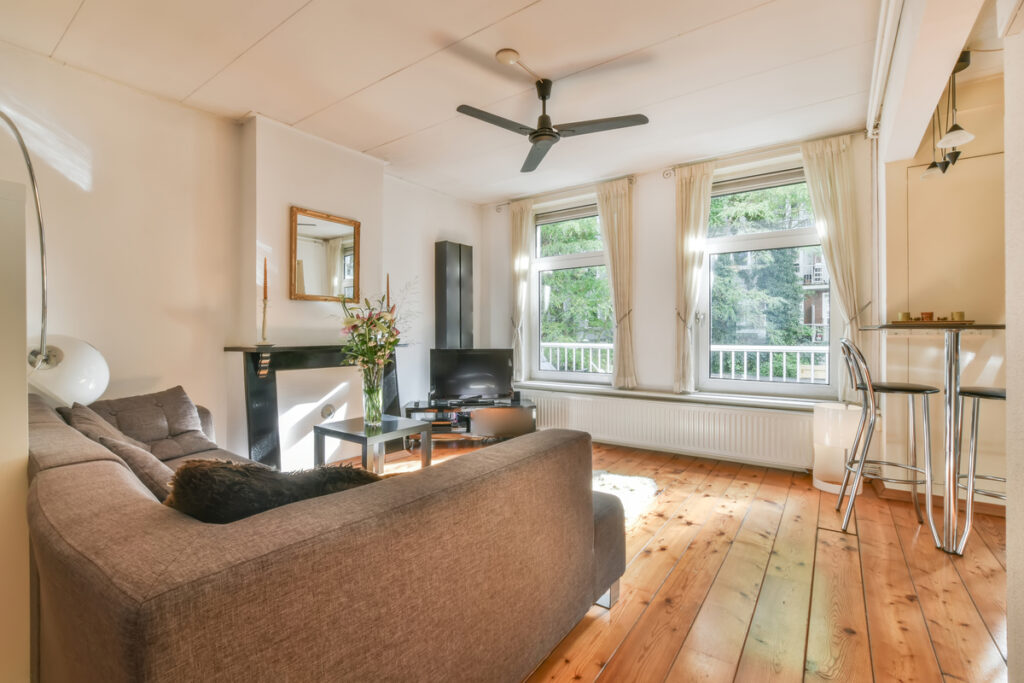
Walk out of a room with the fan still spinning and nothing about the air has changed. A ceiling fan doesn’t make a room cooler, it makes you feel cooler, and that difference is the reason it uses so little energy.
What a ceiling fan really changes
A ceiling fan is simply a set of blades on a hub that circulates air. It does not lower the air temperature or the relative humidity, which is what separates it from an air conditioner. What it does is increase the speed of the air moving across your body. That helps sweat evaporate and speeds up heat exchange by convection, so your skin loses heat more easily.
The motor also adds a small amount of waste heat to the room, partly from the motor itself and partly from friction. This is why the fan only helps people, not empty rooms. If nobody is there to feel the breeze, switching it off saves energy and costs no comfort at all.
Why cooling people is cheaper than cooling air
Cooling air is thermodynamically expensive, while moving it is not. A fan works directly on the body rather than on the room, and as a result it uses significantly less power than air conditioning. Because moving air is generally preferred over still air in warm conditions, people can be comfortable at a higher room temperature.
That opens up a practical combination. With a fan running, an air conditioner’s thermostat can be set a few degrees higher than usual. The air conditioner can also be left on a low fan setting while the ceiling fan, which moves air far more efficiently, does the circulating. In warm, humid places, fans are an especially economical choice.
The switch most people never touch
Many ceiling fans can spin in either direction, usually through a small switch on the motor housing or the base. For cooling, the blades should push air downward, which on most models means counterclockwise when seen from below (it depends on the manufacturer). That creates the breeze on your skin.
In winter the logic flips. Warm air rises and collects near the ceiling, while cooler air settles near the floor where people actually sit. Set to push air upward, the fan drives that warm air out along the walls and back down into the room, without blowing a stream of air straight at the occupants. With the heat evened out, the heating thermostat can be set a few degrees lower. Only fans built to be reversible can do this. Many older models are not, or need their blade pitch adjusted by hand.
There are exceptions to the usual rule. In a hallway, or in a bedroom with a loft bed close to a wall, an upward flow can sometimes give a better breeze.
An old idea that keeps coming back
The first electric ceiling fan was built in 1882 by Philip Diehl, who adapted a motor from an early Singer sewing machine. Before that, versions powered by running water and belts cooled shops and restaurants in the southern United States. The oldest form of all is the punkah, a large leaf swung back and forth, first used in India around 500 BC.
In the United States the fan almost disappeared in the 1960s as air conditioning spread. In countries such as India, Pakistan and Bangladesh it never went away. In many Indian middle-class homes it is still the main way of cooling. It came back to the United States in 1973, when Hub Markwardt began importing fans made in India under a brand called Encon, short for “energy conservation”. Sales took off during the energy crisis of the late 1970s and early 1980s, because the fans used less electricity than the old American motors.
Where it falls short
A fan is not a cooling system. In very hot conditions it can make a room feel more comfortable, but it cannot make the air itself cooler. Its benefit also depends on being matched to the room: a fan that is too small does little, and one hung too close to a light fixture can cause a flickering, strobing effect.
The technology is still improving. Newer fans with brushless DC motors are considerably more efficient than traditional AC-driven ones, and many come with remote or app controls and quieter operation.
A small tool with a real role
Used well, a ceiling fan sits between doing nothing and running a full air conditioner. It lets people feel comfortable at a slightly warmer temperature in summer and a slightly cooler one in winter. It is not a replacement for good insulation or shade, but it is a low-power piece of equipment that works with them.