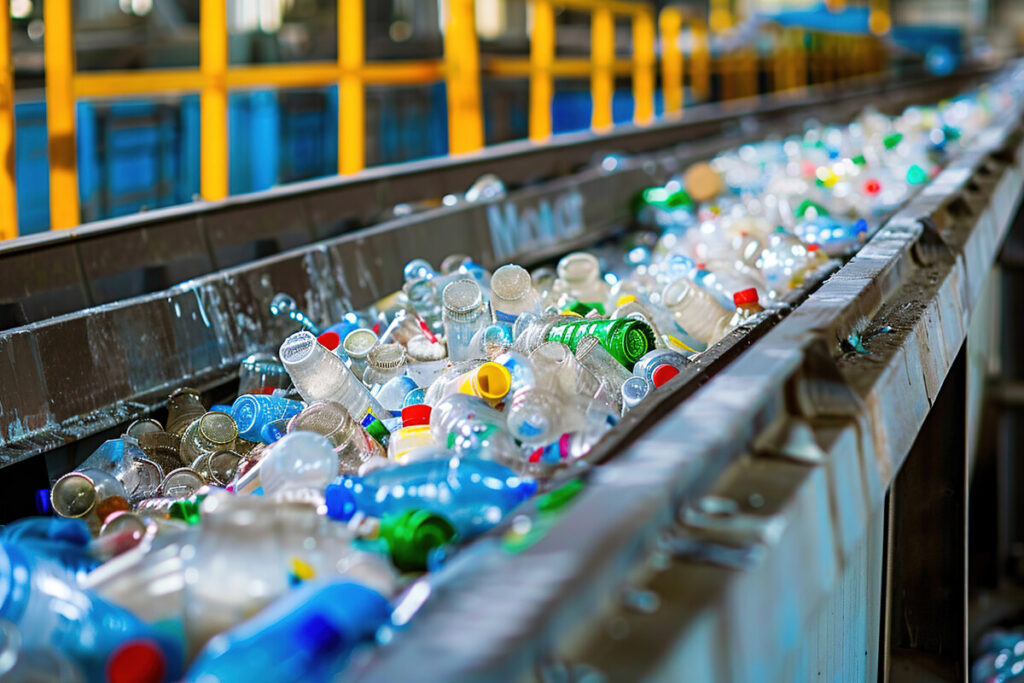
You sort your bottles and cans into the recycling bin and assume they come back as new bottles and cans. Often, they don’t. A lot of what we call “recycling” is actually something else: downcycling, where a material comes back as a lower-grade product instead of an equivalent one. The distinction sounds technical, but it explains a lot about why some materials get recycled again and again while others quietly disappear after one trip through the system.
What recycling and downcycling actually mean
Recycling, in the strict sense, is closed-loop: a material is processed and comes back as the same kind of product, ready to go through the cycle again. Aluminum cans are the closest thing to a textbook example, since recycling aluminum uses about 95% less energy than producing it from raw ore, and a can can be melted down and reformed into another can with little loss of quality.
Downcycling is open-loop: the material is recovered, but it comes back as something of lower quality or a different, less demanding use. A plastic bottle turned into carpet fiber or a stuffing material has technically been “recycled,” but it hasn’t closed the loop, and that carpet fiber usually can’t be recycled again afterward.
How the sorting and reprocessing actually works
Most curbside plastic is marked with a resin code from 1 to 7, a system introduced by the plastics industry in 1988 to identify the type of plastic used. In practice, only types 1 (PET, common in soda bottles) and 2 (HDPE, common in milk jugs) are widely recycled, because they’re the easiest to sort and reprocess at scale. Materials pass through material recovery facilities, where automated systems separate them by type; a single facility can sort an entire truckload of mixed recyclables in under an hour. What’s easy to miss is that collection, not sorting or reprocessing, is where most of the cost sits: roughly two-thirds of the total cost of recycling comes from picking materials up in the first place, not from what happens to them afterward.
A concrete example: why plastic wears out fast
Unlike aluminum or glass, most plastics can only be recycled two or three times before their quality degrades too far to be useful again. Each melt-and-reform cycle shortens the polymer chains that give plastic its strength, so a bottle recycled into fiber, then into a lower-grade product, then typically reaches the end of the line and heads to a landfill or incinerator. Recycling steel saves about 60% of the energy needed to produce it from virgin material, paper saves around 40%, and glass saves 5% to 30%, figures that show just how differently each material behaves once it enters the recycling stream.
Common misunderstandings about recycling
The biggest one is assuming that anything placed in a recycling bin gets recycled indefinitely. In reality, plastic’s limited number of reprocessing cycles means most of it is downcycled once and then discarded. There’s also a common assumption that recycling always makes financial sense: a 1993 industry report found that processing a ton of material at a buy-back center cost about $50, while that same ton could only be resold for around $30. The environmental case for recycling can still hold even when the economics don’t, which is part of why public programs exist rather than relying purely on market pricing.
The bigger picture
None of this makes recycling pointless, it just means the word covers more than one outcome. A Technical University of Denmark study found recycling to be the most effective household waste disposal method in 83% of the cases it examined, and cities like San Francisco have pushed landfill diversion rates as high as 80%. Knowing the difference between recycling and downcycling doesn’t change what goes in the bin, but it does explain why some materials, like aluminum, can loop almost forever, while others get one useful second life before their journey ends.