E-bikes are often dismissed as a shortcut for people who don’t want to pedal. The numbers tell a more interesting story: riders still exercise, they tend to ride further, and the carbon gain depends far less on the motor than on which journey the bike replaces.
What actually counts as an e-bike
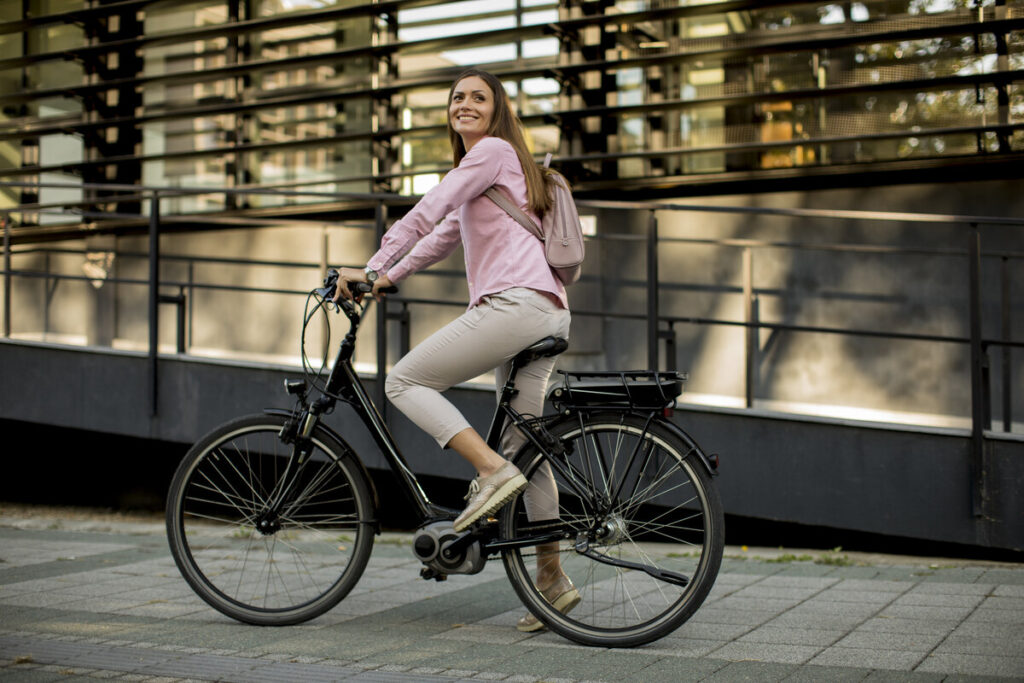
An e-bike is a bicycle with an integrated electric motor that assists propulsion. Most fall into two families. On a pedelec (short for pedal electric cycle), a sensor detects pedaling and the motor only adds to the rider’s effort. On a power-on-demand model, a handlebar throttle runs the motor, a little like a scooter.
In the European Union, the EN15194 standard sets the line. A pedelec is legally a bicycle if the assistance above 6 km/h only works while you pedal, the motor cuts out at 25 km/h, and its continuous rated power stays at or below 250 W. Faster “speed pedelecs”, which keep assisting beyond 25 km/h, are usually treated as mopeds in Europe.
Typical range is 40 to 120 km per charge, depending on how much assistance you use. And when the battery runs flat, almost every e-bike simply works as a regular bike.
You still pedal, and often further
The “cheating” reputation is only half right. A study from the University of Tennessee found that energy expenditure on an e-bike is 24% lower than on a conventional bicycle, with the gap widest on uphill sections.
But people don’t ride e-bikes the same way. In a study of seven European cities, e-bike users had a 10% higher weekly energy expenditure than other cyclists, because they made longer trips. A 2008 survey in the Netherlands points the same way: the average commute was 6.3 km on a standard bicycle and 9.8 km on an e-bike. The assistance also brings in older riders and anyone put off by hills or headwinds.
How the carbon numbers compare
An e-bike emits nothing while you ride, but electricity generation and the manufacturing and recycling of its battery still count. A 2010 study found e-bikes were 18 times more energy efficient than an SUV, 13 times more than a sedan and 6 times more than rail transit, with roughly the same environmental impact as a conventional bicycle.
Figures published by the European Cyclists’ Federation in 2011 add a surprising twist. Over their full life cycle, e-bikes averaged 15 g of CO2e per passenger-kilometer, against 21 g for a regular bike. The difference comes from food: a cyclist without a motor burns extra calories, and producing that food has a carbon cost. Driving an electric car alone came out at about 50 g, and a bus with ten passengers at about 100 g.
Why those figures need care
These comparisons are very approximate. The same source notes that an e-bike rider whose extra calories come from beef could cause more than 570 g of CO2e per kilometer. So the honest reading is not that e-bikes beat bicycles, but that both sit far below cars.
The trip it replaces is what matters
The real climate effect comes from car journeys that become bike journeys. A 2018 study in England estimated that e-bikes, if used widely to replace car travel, could “cut car carbon dioxide (CO2) emissions in England by up to 50% (about 30 million tonnes per year)”.
A 2020 study of the Yorkshire region added a nuance: the biggest opportunities are in rural and suburban areas, not city centers. City dwellers already have many low-carbon options. It is the same logic behind counting the cars a shared car actually replaces: the benefit depends on what people stop doing.
A few things worth knowing before buying
The battery is a significant part of an e-bike’s price. Charging at room temperature and using shallow discharge and recharge cycles help extend its life, and lithium-ion batteries have no memory effect, so topping up partially carries no penalty.
Battery fires have drawn scrutiny since 2019, mostly linked to lower-quality batteries and loose regulation. Problems are very rare among large, established manufacturers, and cities such as New York and San Francisco now require batteries sold there to be UL certified.
Speed is the other point to keep in mind. A 2014 study found German e-bike users were no more likely than other cyclists to face safety-critical situations, but drivers can underestimate how fast an e-bike is approaching.
A bike that is changing who cycles
E-bike sales in the EU passed 5 million in 2021, up from 200,000 in 2007. In 2022 they made up 57% of bike sales in the Netherlands and 48% in Germany. The motor doesn’t make the rider lazier; for many people, it makes cycling a realistic option in the first place.