Washing up by hand often feels like the low-impact option, while the dishwasher looks like a convenience with a hidden cost. The research on the question tells a more interesting story, and the answer depends far more on how each method is used than on the method itself.
What a dishwasher actually does differently
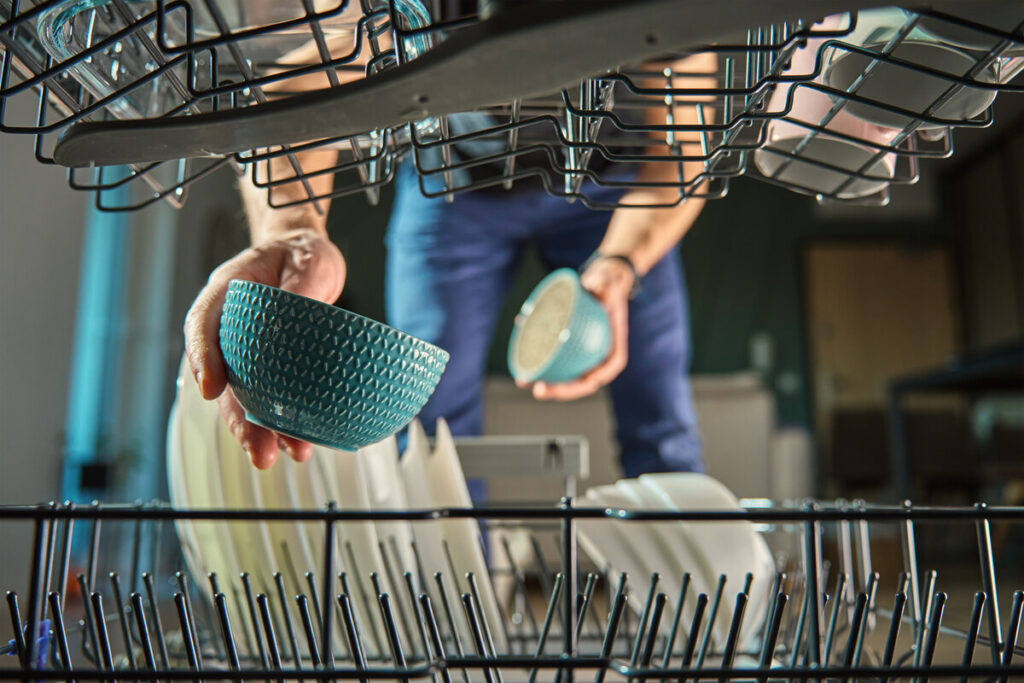
Hand washing relies on physical scrubbing to lift food and grease. A dishwasher works another way: it sprays hot water, typically between 45 and 75 °C, at the dishes through one or more rotating sprayers. The key detail is that the mix of water and detergent is recirculated during the wash to save water and energy, instead of running continuously down the drain.
A typical cycle includes an optional pre-rinse, a main wash with fresh water and detergent, one or more rinses, and a drying phase. A small dose of rinse aid in the final rinse lowers the surface tension of the water so it drips off instead of leaving spots, which also helps items dry.
What the numbers show
A peer-reviewed study published in 2003 compared people washing and drying, by hand, the same amount of dishes as a fully loaded dishwasher (without pots or bakeware). Hand washers used between 20 and 300 litres of water and between 0.1 and 8 kWh of energy, while energy-efficient dishwashers used 15 to 22 litres and 1 to 2 kWh. The hand washers also needed between 65 and 106 minutes for the job.
The study concluded that a full dishwasher uses less energy, water and detergent than the average European hand washer. For a sense of scale on the machine side, Energy Star certification in the United States requires a standard dishwasher to use no more than 270 kWh per year, or 203 kWh for a compact model.
Why the comparison is not as simple as it looks
Hand washing covers a huge range
That gap between 20 and 300 litres is the real story. Hand-washing techniques vary enormously from one person to the next, and there is one clear exception to the general rule: small quantities washed in a bowl or basin, without running water, can beat the machine.
The study has its critics
Several points have been raised against it. Electricity used by the machine was compared with the energy needed to heat water, without accounting for possible losses along the way. The study also set average, sometimes wasteful, hand washing against the best possible use of a full dishwasher. In that ideal case the dishes were not rinsed first, yet manual pre-rinsing before loading can use up to 100 litres of water on its own. The research also left aside the manufacture and disposal of the machine, washing cookware, and the extra wear detergent can cause on dishes.
Not everything belongs in the machine
Strong alkaline detergents, hot water and agitation are hard on some materials. Aluminium, brass and copper can discolour, non-stick coatings deteriorate, wooden boards and glued handles soften, and the seasoning on cast iron pans gets stripped away. Lead crystal is a special case, since the hot, alkaline wash can make its lead soluble.
Small settings that change the result
Modern machines already help. Since the late 1990s, many dishwashers have used soil sensors that measure the food particles coming off the dishes and adjust the washing time, so the machine runs only as long as it needs to.
Drying is another lever. Machines that dry with an exposed heating element tend to be less efficient than passive drying, and US government agencies often recommend letting dishes air-dry by switching off or stopping the drying cycle. Some models use a desiccant called zeolite, which soaks up moisture during the drying phase and saves significant energy.
Detergent has changed too. Phosphates, once common, have been banned in many regions because they feed algal blooms in waterways, and most manufacturers have removed them from all their dishwasher detergents.
A choice shaped by kitchens as much as by habits
Whether the question even comes up depends on where you live. Around 75% of US households have a dishwasher, and ownership is above 70% in countries such as Germany. It stays below 30% in Greece and Romania, where outdated plumbing is the main barrier, and is estimated at 3.2% in China and 0.5% in India, where small kitchens and very oily or spice-heavy cooking make standard machines less practical.
So there is no automatic winner. A full machine run without pre-rinsing is usually the most frugal option in the studies available, while a careful wash in a basin can hold its own for a small pile of plates. The difference, in the end, comes down less to the tool than to the way it is used.