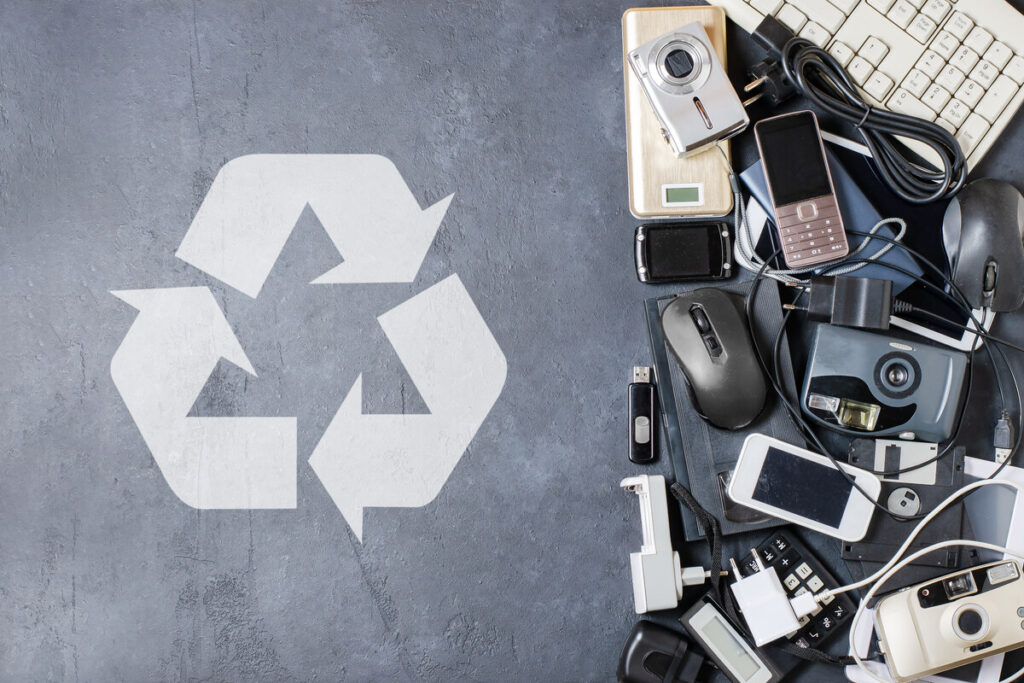
An old phone in a drawer, a laptop that stopped charging, a tangle of cables nobody can identify: almost every home has a small stash of electronic waste. Globally, that stash adds up to a record amount, and only a fraction of it is ever formally recycled. Here is what e-waste actually is, why so much of it slips through the system, and what happens to the devices that do get collected.
What counts as e-waste
Electronic waste, also called e-waste or WEEE (waste electrical and electronic equipment), simply means discarded electrical or electronic devices. That covers far more than phones and computers. The European Union sorts it into ten categories, from large household appliances to small gadgets, which is why a broken toaster or an old electric toothbrush belongs in the same family as a smartphone.
The volume is growing quickly. Around 62 million tonnes of e-waste were generated worldwide in 2022, a record and an 82% increase since 2010, with projections reaching 82 million tonnes by 2030. For comparison, the figure for 2016 was 44.7 million tonnes.
Why so little of it gets recycled
Only 22.3% of the e-waste generated in 2022 was formally collected and recycled. The rest does not simply vanish. A detailed study of Europe, based on 2012 data, gives a useful picture of where it goes: only 35% (3.3 million tonnes) of discarded electronics went through official collection and recycling. Of the remaining 6.15 million tonnes, about 1.5 million tonnes were exported, 3.15 million tonnes were recycled outside the official standards within Europe, 0.75 million tonnes were scavenged, and another 0.75 million tonnes ended up in ordinary household bins.
In other words, the main gap is not that people refuse to recycle. It is that devices leave the formal system through many side doors, from the general bin to informal scrap networks, which is also why a zero waste approach puts so much weight on what happens before a device is thrown away.
Why old devices are worth recovering
E-waste is both valuable and hazardous, and that combination explains most of the debate around it. On the valuable side, circuit boards contain gold, silver, platinum, copper, iron and aluminium. E-waste holds roughly 100 times more gold per tonne than gold ore, and as much as 7% of the world’s gold may be sitting in discarded electronics. Inadequate recycling is estimated to lose about 62 billion US dollars of key raw materials every year.
On the hazardous side, electronics can contain lead, mercury, cadmium, beryllium and brominated flame retardants. When devices are burned or stripped without proper equipment, they can release dioxins, furans and heavy metals. At Agbogbloshie in Ghana, a well known scrap site, lead levels in the soil have been measured at up to 18,125 ppm, against a US Environmental Protection Agency standard of 400 ppm for children’s play areas.
What is often misunderstood
Not every exported device is dumped
Exports are often described as pure dumping, but the picture is more mixed. A 2011 study of imports into Ghana found that 70% were used devices, of which 15% were scrapped. Research from Arizona State University found that 87 to 88% of imported used computers sold for more than the value of their materials, a sign that many were bought to be used again. The real problem is the share that ends up in informal processing without protection for workers or soil.
Recycling is not the first step
Reuse extends a device’s life and postpones the moment it needs recycling at all. Repair cafés and initiatives such as the Restart Project help people fix devices rather than replace them, an idea at the heart of the right to repair movement. Selling or donating a working device keeps it in use longer than any recycling plant could.
A factory reset is not always enough
Discarded equipment can still hold readable personal data, and a factory reset may not fully erase it. That is one reason manufacturer take-back programmes (Apple and Samsung both run them) and certified recyclers, such as those holding the R2 or e-Stewards certifications encouraged by the US EPA, are worth looking for.
Where things are heading
Rules are slowly catching up. The Basel Convention, adopted in 1989, regulates cross-border movements of hazardous waste. The EU’s WEEE Directive came into force in 2003 and was recast in 2012, requiring producers to design products so that reuse is not restricted. Japan went further by making manufacturers responsible for recycling their own products, which pushed some to rethink their design and sell the metals they recovered. With volumes still rising, the most effective lever may be the simplest one: keeping devices in use for longer, then making sure they reach someone equipped to take them apart safely.