Turning old fire hoses into handbags or a broken chair into a planter sounds like the greenest thing you can do with waste. Upcycling often is a smart choice, but the word has a precise meaning, and it doesn’t automatically beat every other option. Here’s what it actually covers and where its limits are.
What upcycling actually means
Upcycling, sometimes called creative reuse, is the process of transforming by-products, waste materials or unwanted objects into new materials or products seen as having greater quality or value than what you started with. That value can be practical, artistic or environmental.
It sits inside the broader family of recycling, but it works differently. Classic recycling usually turns a material back into its original form: plastic bottles are broken down into polymers, which become new bottles. Downcycling goes the other way and turns waste into something of lower quality. Upcycling aims for the opposite direction, adding value instead of losing it.
An old habit with a new name
Before the Industrial Revolution, repairing and reusing goods was simply normal, and the person fixing an object was often the person using it. The writer Alvin Toffler later coined the word “prosumer” for this blend of producer and consumer. Mass production in the 18th and 19th centuries separated those roles and encouraged a buy, use and throw away model.
The term itself is much younger. “Upcycling” and “downcycling” first appeared in print in 1994, in an article by Thornton Kay in SalvoNEWS quoting Reiner Pilz. Gunter Pauli’s 1998 book on the subject was retitled Upcycling in 1999, and William McDonough and Michael Braungart built the idea into Cradle to Cradle in 2002, framing it as a way to stop wasting useful materials and cut demand for new raw ones.
Interest then grew quickly online. On Etsy, Pinterest and Upcycle Studio, products tagged “upcycled” went from about 7,900 in January 2010 to 263,685 by April 2013.
What it looks like in real life
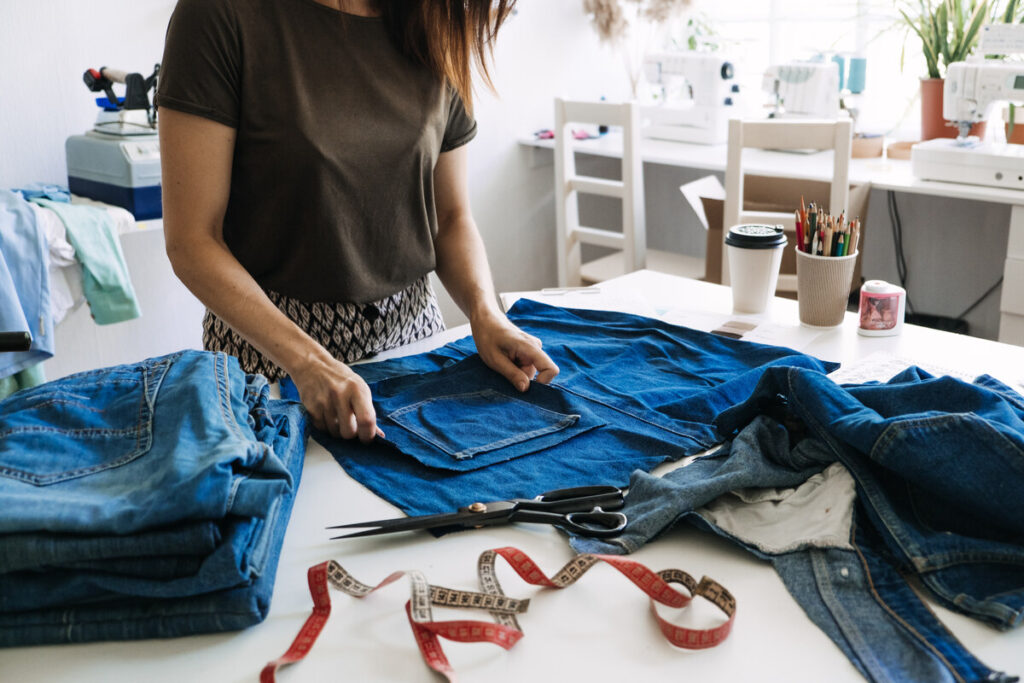
Some of the clearest examples come from design and fashion. Since 2005, the brand Elvis & Kresse has turned decommissioned fire hoses into luxury accessories, donating 50% of its profits to The Fire Fighters Charity. Other designers build entire collections from fabric scraps, using either factory offcuts left over from cutting patterns (pre-consumer waste) or used clothing (post-consumer waste).
Art got there long before the word existed. Amish quilts were made from salvaged fabric, and Simon Rodia’s Watts Towers in Los Angeles, built between 1921 and 1954, turned scrap metal, pottery and broken glass into 17 structures, the tallest rising over 30 meters. In Paraguay, the Recycled Orchestra of Cateura plays instruments made from materials taken from the Asunción landfill.
Industry uses the idea too. Refurbishing second-hand electronics counts as upcycling because it needs less energy and material than making new devices. Breweries can feed their spent grain into biogas plants, which can generate a profit of roughly 20% of operating costs depending on the substrate’s price.
Where upcycling has its limits
Energy is the real test
In the strict material sense, raising a material’s quality usually means adding more energy. Two questions help judge any recovery option: how much energy does it take to bring the material back to the quality you need, and how does that compare with making it from virgin material? For second-hand clothing the answer is very little. In other cases, recovering a material can take more energy than starting fresh.
Not every material cooperates
Mixed plastics are a good example. When different types are blended during recycling, the resulting hybrid is often turned into plastic lumber, but it can suffer from phase separation that leaves it structurally weaker. Wrought aluminium alloys, similarly, are often melted down into lower-grade casting alloys because restoring their original quality isn’t practical or economic.
It’s a complement, not a cure
Upcycling is one tool among several. In the US alone, around 85% of textiles still end up in landfills even though most could be recycled. Creative reuse helps, but it works best alongside repair, recycling and simply keeping things in use longer.
A useful way to think about waste
The most lasting idea behind upcycling may be the change of perspective it asks for: looking at a discarded object and asking what else it could become. Whether that’s a jacket rebuilt from scraps or a refurbished laptop, the goal is the same, to keep useful materials in circulation a little longer, while staying honest about the energy it takes to do so.