Clothes dryers have a reputation as one of the hungriest appliances in the home, and in many countries that reputation is earned. But the gap between one dryer and another is far wider than most people realize, and line drying has trade-offs of its own.
What a tumble dryer really does
A tumble dryer removes moisture from washed textiles by passing heated air through a rotating drum, called a tumbler. The rotation keeps space between the clothes so the warm air can reach every piece and evaporate the water.
That evaporation is the expensive part. A typical 4 kg load can still hold about 2.2 kg of water after the washing machine’s spin cycle. Turning that water into vapor takes roughly 4,965 kilojoules, or about 1.4 kWh of heat, whatever method you use. The question is how much extra energy each method spends on top of that, and where the heat comes from.
Three types of dryer, three very different energy bills
The classic vented dryer draws in air from the room, heats it with a gas flame or an electric element, sends it through the drum, then pushes the hot, humid air outside. All that heat leaves the house with it. A conventional electric dryer uses from 3 to 9 kWh to dry an average load.
A condenser dryer keeps the air inside the machine. A heat exchanger cools the moist air so the water condenses into a tank or drain pipe, and the drier air goes back into the drum. It typically needs around 2 kWh per load, though it runs a little longer, and the heat it removes ends up warming the room.
A heat pump dryer goes one step further. Its cold side condenses the water vapor, and its hot side reheats the air for another pass, so much of the heat is recycled instead of thrown away. The result is about 1 kWh per average load, under half the energy of a condenser model. It is the same principle explained in our article on how a heat pump moves heat instead of making it.
Why the numbers matter at scale
In the United States and Canada, more than 80% of homes have a clothes dryer, and in America dryers are the second largest residential electricity user after refrigerators and freezers. The US Environmental Protection Agency has estimated that if every residential dryer sold in the country were energy efficient, “the utility cost savings would grow to more than $1.5 billion each year and more than 10 billion kilograms (22 billion pounds) of annual greenhouse gas emissions would be prevented”.
Ownership varies a lot: around 60% of UK households have a dryer, against about 30% in South Korea.
Where line drying fits in
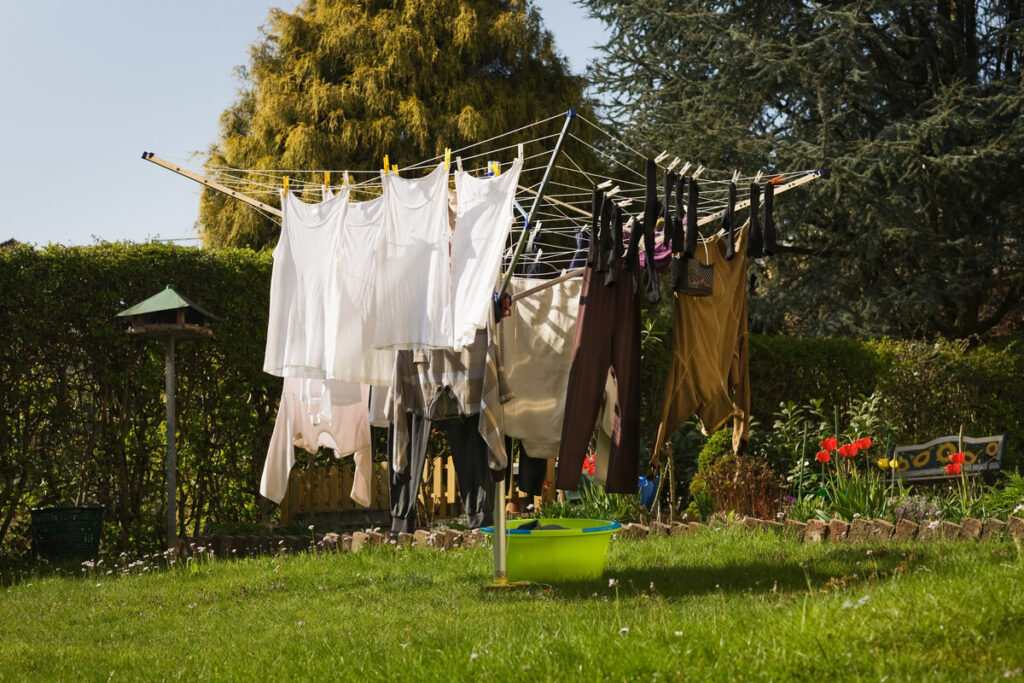
A clothesline uses no electricity at all, compared with roughly 2 kg of CO2 equivalent per load for an average mechanical dryer. It also saves money and causes less wear on fabrics, since tumbling can shrink clothes or strip away short, soft fibers.
Speed depends on the weather: temperature, humidity, wind and direct sun all play a part, which is why thick items usually go on the most exposed line.
Common mistakes and nuances
Indoor drying is not entirely free
Drying on an indoor rack takes the heat for evaporation from the room’s air, cooling it slightly and raising humidity. That can feel pleasant in cold, dry weather, but in a damp home extra moisture can encourage mold. Good ventilation helps.
Every dryer has its own limits
Condenser dryers release their heat into the room, which is welcome in winter and less so in summer. Domestic heat pump dryers are designed for ambient temperatures between 5 and 30 °C, and drying times rise noticeably below that range.
Small habits change the result
A faster spin in the washing machine leaves less water to evaporate. Sensor dryers that stop once clothes are dry avoid over-drying, which wastes energy and is a common cause of static cling. Cleaning the lint filter after each cycle also matters, because a clogged vent markedly increases drying time and is a fire risk.
A small choice with a long history
Dryers only became common in American homes after the 1960s, and for a time clotheslines were seen by some as a sign of poverty. By 2009, most of the 60 million people living in US private communities were not allowed an outdoor line. That prompted “right-to-dry” laws, and by July 2025 nineteen states, from California to Vermont, had passed rules preventing such bans.
For most households, it is not all or nothing. Air drying when the weather allows, and picking an efficient machine for the rest of the time, are both ways to bring one of the home’s largest energy users down to size.