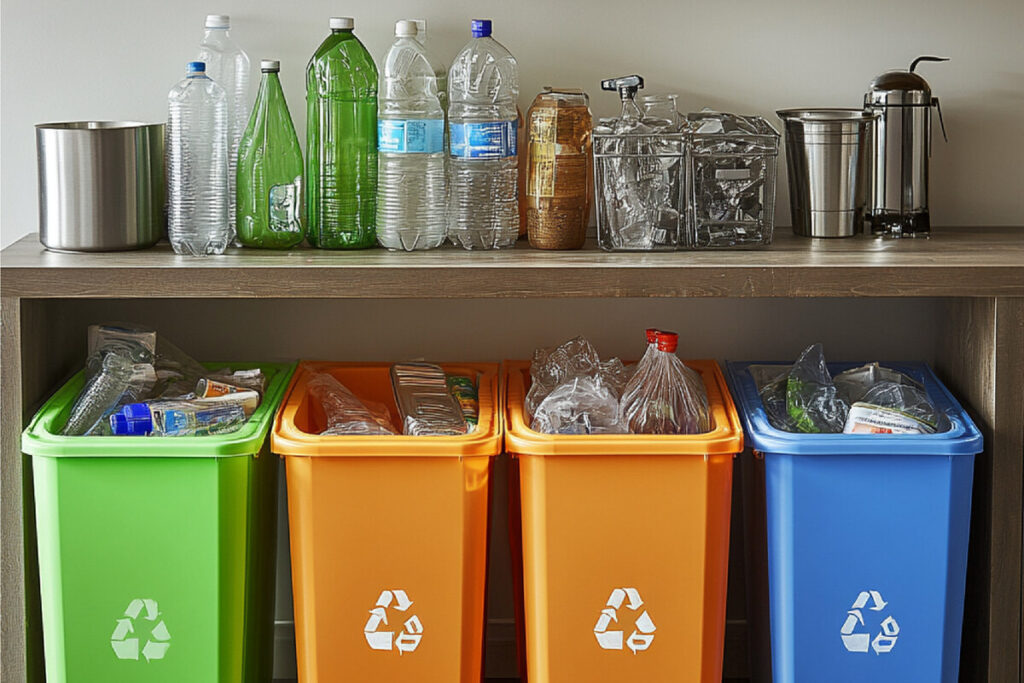
Most people assume that avoiding waste is always the greenest choice, and that recycling should only be a fallback before landfill. The official waste hierarchy tells a more nuanced story.
What the waste hierarchy actually ranks
The waste hierarchy is a framework, formalized across the European Union in Directive 2008/98/EC, that ranks five ways of handling waste from most to least preferred: prevention, reuse, recycling, recovery, and disposal. The idea goes back further than that directive: in 1979, Dutch politician Ad Lansink proposed a similar ranking known as “Lansink’s ladder,” which became part of Dutch policy in 1993, well before the EU adopted its own five-step version in 2008.
Under this system, preventing a product from becoming waste in the first place ranks above reusing it, reusing ranks above recycling, and recycling ranks above recovery, such as burning waste for energy, which in turn ranks above sending waste to a landfill.
Why the order isn’t a strict rulebook
Here’s where the common assumption breaks down. The hierarchy is meant to guide overall priorities, not dictate every individual decision automatically, because the ranking alone doesn’t account for a product’s full life cycle.
A washing machine that proves the point
Consider an old, energy-inefficient washing machine. Followed literally, the hierarchy would suggest that keeping the appliance running counts as “prevention,” the top-ranked option, while replacing it simply creates new waste. But most of a washing machine’s environmental impact happens during its years of use, through the water and energy each wash consumes, not during manufacturing or disposal. Swapping an old, inefficient machine for a newer, more efficient one can lower its total environmental footprint, even though doing so technically produces waste sooner than “prevention” would imply.
Recycling and recovery aren’t the same thing
Another frequent mix-up is treating recycling and energy recovery as interchangeable, when the hierarchy places them at clearly different levels. Recycling, which includes composting, turns discarded material back into new products or resources. Recovery, most often incineration, extracts energy from waste but doesn’t return the material itself to use. The hierarchy consistently ranks recycling above recovery, since reprocessing material keeps more value in circulation than burning it once for energy.
The hardest part usually isn’t technical
Applying the hierarchy in practice runs into obstacles that have little to do with the ranking itself: coordinating waste policy between local and regional authorities, financing the infrastructure that reuse and recycling programs need, and simply gathering enough reliable data to know which option is actually better in a given case. Pay-as-you-throw pricing, where households are charged based on the volume of waste they produce, is one policy that has measurably reduced municipal waste by shifting the incentive further up the hierarchy, toward prevention rather than disposal.
A framework for thinking, not a formula
The waste hierarchy remains a useful default: all else being equal, preventing waste beats reusing it, and reusing beats recycling. But treating it as an unbreakable formula misses the point Lansink’s ladder and the EU directive were built on in the first place, which is reducing overall environmental harm, not following five steps in the same order every time. Life-cycle thinking, looking at where a product’s real impact actually happens, is what should decide the best option, and sometimes that means moving down the ladder rather than up it.