Unplug your phone charger when you’re done, the advice goes, or it will keep quietly draining power. There is some truth in that, but the picture has changed a lot in the past twenty years. Most of the standby electricity in a home today comes from somewhere else, and a simple rule of thumb shows where it is worth looking.
What standby power actually is
Standby power, sometimes called vampire power, phantom load or ghost load, is the electricity a device uses while it looks switched off. It is not wasted by accident. It powers the receiver that waits for your remote control, keeps a clock or display running, or lets a device start up instantly instead of warming up the way old tube televisions did.
The US Department of Energy summed it up in 2008: “Many appliances continue to draw a small amount of power when they are switched off.” Oddly, it still has no formal definition.
The rule of thumb that puts it in perspective
The easiest way to judge standby power is to remember one number: each watt drawn around the clock adds up to about 9 kWh a year (1 watt multiplied by the 8,766 hours in a year). At average US electricity rates, that comes to roughly $1 a year for every watt.
That is why the charger example is a little misleading. Older power adapters, the heavy ones that feel warm to the touch, can draw several watts. But newer lightweight adapters that stay cool may use less than one watt, which means unplugging one saves around a dollar a year. Helpful, but hardly the main event.
Where standby power really adds up
The bigger numbers come from devices that stay “on” in the background. As of 2011, computers typically drew 2 to 8 watts in standby. Older devices of all kinds can reach 10 to 15 watts each.
Game consoles are a good illustration of how much settings matter. A Wii console can drop from 18 watts to 8 watts to just 1 watt in standby by turning off its WiiConnect24 and Standby Connection features. Using the rule of thumb, that one change is worth roughly 150 kWh a year.
Add everything up and standby can be significant. Before efficiency rules tightened, standby accounted for 8 to 22 percent of appliance consumption depending on the country, or 32 to 87 watts per home, around 3 to 10 percent of total residential electricity. In the UK, standby modes made up 8% of residential power in 2004, and in France about 7% in 2000.
Why the problem has shrunk
In 1999, the International Energy Agency launched the One Watt Initiative, aiming for every new appliance to use one watt or less in standby by 2010. Governments followed. In 2001, a US executive order required federal agencies to buy products drawing no more than one watt in standby, and in 2007 California capped external power supplies at 0.5 watts.
The European Union went further with Regulation 1275/2008. From January 2010, off mode and standby were limited to 1 watt (2 watts for so-called standby plus modes), and those limits were halved in January 2013. As a result, a modern HD LCD television may use less than 1 watt in standby.
Common mix-ups worth knowing
Smart strips need to pay for themselves
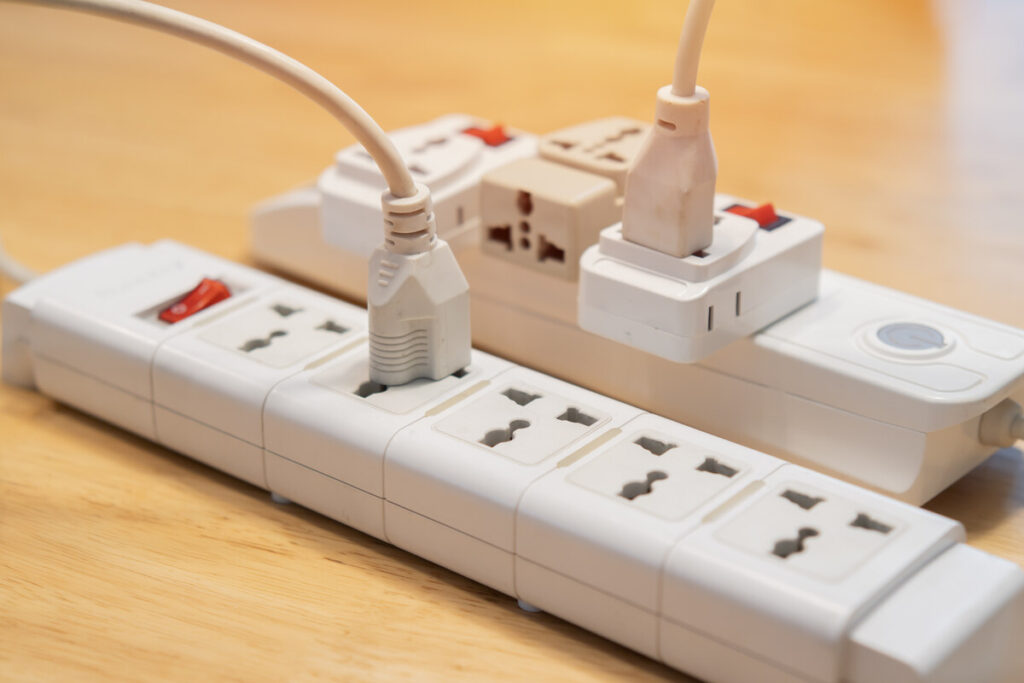
Switched power strips, timers and home automation can cut standby use, but only if the controller itself draws less power than the equipment it switches off. Otherwise the gadget simply becomes the new phantom load.
Cheap plug-in meters are not always accurate
Plug-in wattmeters cost around $10, but they are often imprecise at very low readings. One workaround is to measure a steady load, like an incandescent bulb, then add the standby device and subtract the difference.
Fully charged does not mean zero
Devices with rechargeable batteries keep drawing standby power even once they are full, which is worth keeping in mind for gadgets that live on their chargers.
A smaller problem, but not a solved one
Standby power is a good example of a problem that regulation and better design have shrunk considerably, without making it disappear. Researchers at Lawrence Berkeley National Laboratory have suggested that cutting standby use by around 75% overall is probably technically feasible. For households, the practical takeaway is less about unplugging every charger and more about spotting the few devices that idle at several watts. If you are curious about other low-effort habits, our guide to cutting your energy use without a big renovation covers the basics, and our look at why energy efficiency doesn’t always save as much as you’d expect explains why savings on paper don’t always show up on the bill.