Bottled water gets blamed for a lot, from plastic waste to wasted resources. The numbers tell a more mixed story: it is lighter on water than most other bottled drinks, but the real questions sit in the packaging and in what people choose to drink instead.
How much water does a bottle of water really use?
On average, producing 1 litre of bottled water takes 1.32 litres of water: 1 litre goes into the bottle and 0.32 litres is used for treatment, bottling and maintenance. Small-pack facilities, which fill containers between 8 oz. and 2.5 gallons, use the least (1.26 litres per litre), while home and office delivery sizes use the most (1.56 litres).
That compares well with other drinks. Bottled soft drinks average 2.02 litres of water per litre, beer 4 litres and wine 4.74 litres, because flavour mixing, carbonation and fermentation all add steps. In the United States, bottled water production represents 0.011% of annual water consumption.
What about energy and emissions?
An industry-commissioned 2011 study from the International Bottled Water Association estimated that producing, packaging and transporting bottled water in the United States uses about 0.07% of the country’s yearly energy and accounts for about 0.08% of its emissions. A separate 2015 study put the lifecycle footprint of a half-litre small-pack bottle at 111 grams of CO2 equivalent, against 240 grams for a same-sized PET soft drink bottle, which needs thicker plastic to hold the carbonation.
These figures come from industry-linked sources, so they are best read as a comparison between drinks rather than as proof that bottled water is harmless. They do show that, gram for gram, the sugary alternative often costs more.
Why the plastic still matters
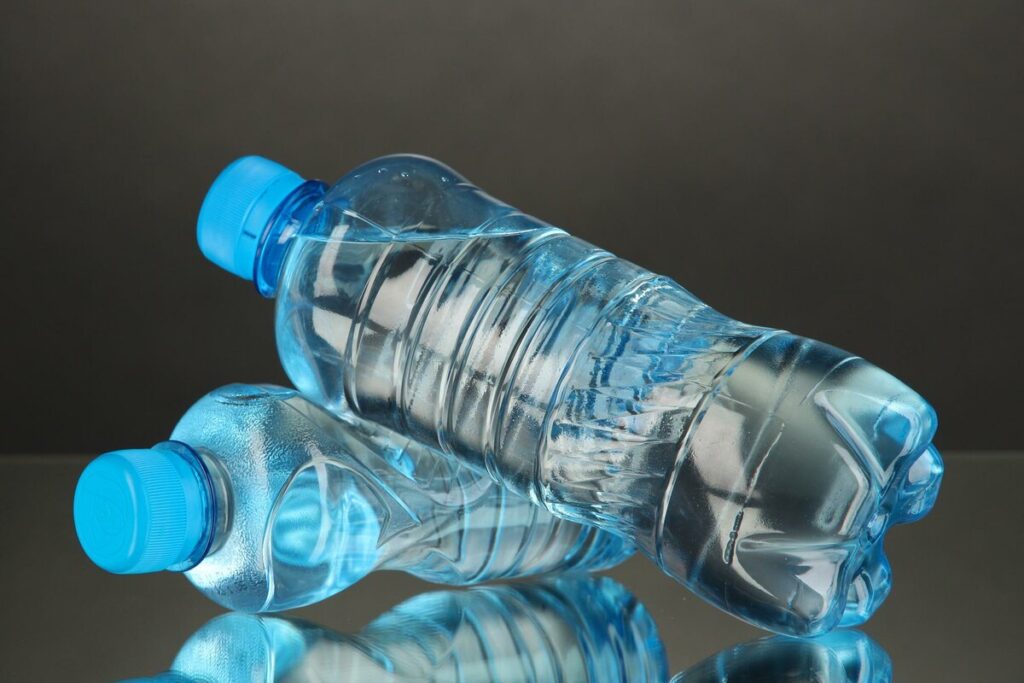
Most single-serve bottled water in the United States and Europe comes in PET, marked with resin code 1. PET is recyclable, and it is the most recycled plastic in both regions, but recycling rates vary: in 2014 the rate for PET packaging was 32% in the United States and about 52% in the European Union. Wherever a bottle isn’t collected, it ends up in the waste stream, and critics also point to the energy used to transport water over long distances.
Recycled PET does find real uses. In Europe, more than one-third of recovered PET becomes polyester fibres and another quarter goes back into containers such as egg cartons and fruit boxes.
Why do people buy it in the first place?
The reasons are mixed: taste, convenience, safety worries, health concerns and a swap for sugary drinks. Several surveys found that bottled water is “mostly consumed as a substitute for alcoholic and traditional soft drinks”, rather than as an alternative to tap water. The exception is when contamination presents serious health risks and trust in the tap water company is badly eroded.
Cost is part of the picture too. In one American study, Black and Latino households reported spending more than twice as large a share of their income on bottled water as white households did, partly because of doubts about tap water safety. In some cases, bottled water can even turn out to be tap water: in the United States, bottled water from a municipal supplier must be labelled as such unless it has been processed enough to be called “distilled” or “purified”.
A fairer way to think about it
Bottled water isn’t a climate villain on its own, and it isn’t a harmless default either. Where tap water is safe, a refillable bottle avoids the packaging question entirely. Where it isn’t, bottled water can be a practical necessity, and a PET bottle that is actually collected and recycled changes the math. The useful comparison is not bottled water versus nothing, but bottled water versus the other things in the fridge.