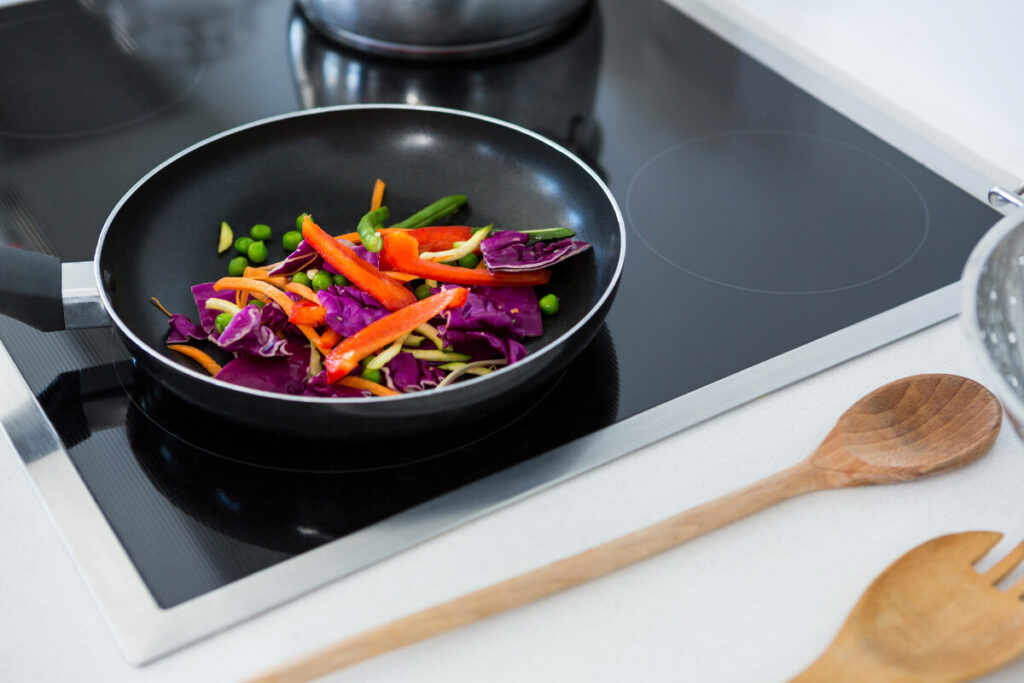
Induction hobs are often described as the most efficient way to cook, a quick and clean alternative to gas. The reputation is mostly deserved, but the real numbers are more interesting than the marketing: the gap with gas is large, the gap with other electric cooktops is smaller, and in a few situations induction is not the winner at all.
What induction cooking actually is
An induction cooktop does not heat itself and then pass that heat to the pan. Under the glass-ceramic surface sits a coil of copper wire carrying an alternating current. This creates an oscillating magnetic field, which induces an electrical current in the metal base of the pan. As that current flows through the metal, it meets resistance and produces heat. In other words, the pan itself becomes the heating element, and the food is warmed by conduction from the base.
That is why the surface stays relatively cool and why heat settings change instantly: there is no burner or hot plate to warm up or cool down.
Why the pan matters so much
Induction only works well with cookware that contains a ferromagnetic metal, such as cast iron or magnetic grades of stainless steel. Copper and aluminium pans usually will not heat on a standard model, because the magnetic field cannot concentrate the current in them. The base also needs to be flat, since heating power drops quickly with distance from the surface.
The easiest check takes a few seconds: if a magnet sticks well to the bottom of a pan, it will work on induction. Many modern “tri-ply” pans combine a magnetic stainless steel skin with an inner layer of aluminium, which spreads heat evenly. Adapter discs exist for non-magnetic pans, but they are much less efficient.
What the efficiency tests show
Gas burners lose a lot of energy heating the surrounding air instead of the pan. Testing by the U.S. Department of Energy in 2013 and 2014, using a standard metal test block, measured an energy transfer efficiency of 70.7% to 73.6% for induction, 71.9% for an electric coil cooktop and 43.9% for gas. Independent tests usually put induction between 74% and 77%, against an average of about 40% for gas.
The difference with electric coils becomes clearer when the pan is small. A 2014 study presented at the ACEEE Summer Study on Energy Efficiency in Buildings found that induction heated water at roughly 76% efficiency whether the pan was small or large. Electric coils dropped from over 80% with a large pan to 40% to 50% with a small one, while gas fell from around 35% to 40% down to 30%.
Where the common claims go too far
It is not always the top performer
A 2023 study of devices for bringing water to a boil ranked the electric kettle as the most efficient option, with induction second. The induction hob’s efficiency ranged from 54% to 81% depending on how much water was heated. For simmering food over an hour, a resistance coil actually did better than induction.
Some old figures were never measured
An 84% efficiency figure for induction circulated in earlier U.S. technical documents. The Department of Energy later noted that it had not been measured in its own laboratories, but referenced from an external study carried out in 1992.
Efficiency at the hob is only part of the picture
When comparing induction with gas, the overall environmental result also depends on how efficiently the electricity is generated, and the running cost depends on local electricity and gas prices. A very efficient hob running on a high-carbon grid is a different story from the same hob on a cleaner one.
The benefits beyond energy
Because so little heat escapes, induction warms the kitchen far less than gas and reduces how much ventilation is needed. Gas stoves are a significant source of indoor air pollution, while induction produces none in the kitchen.
There are trade-offs: the glass surface can crack under a hard impact, heavy pans dragged across it may scratch it, some flame techniques are not possible, and people with pacemakers are usually advised to avoid strong magnetic fields.
An old idea that took decades to catch on
Induction is not new. The first patents date from 1906 and 1909, and in the mid-1950s Frigidaire demonstrated a prototype heating a pot of water with a newspaper placed between the stove and the pot. Yet in 2012, induction still made up only 4% of cooktop sales in the United States. For anyone choosing a new cooktop, the useful takeaway is simple: induction is usually the most efficient hob, but pairing it with the right pans, and a kettle for boiling water, is what gets the most out of it.